
How Regional Accents Are Evaluated by AI Judges
AI judges fail debaters with regional accents at two separate, fixable stages.
AI judging of live spoken debate runs through two separate systems, not one. A debater finishes a speech, and before any score appears, the audio has already passed through an automatic speech recognition (ASR) system that turns it into text, and only then does a large language model (LLM) read that text and judge it. Accent can cause harm at either of these two points, and they are separable: a transcript can be accurate while the judgment is biased, or a transcript can be wrong while the judgment logic is sound. Treating "the AI judge" as one black box hides which system actually failed a given speaker, and that distinction is the starting point for everything that follows.
Why live spoken debate hands control to two separate AI systems
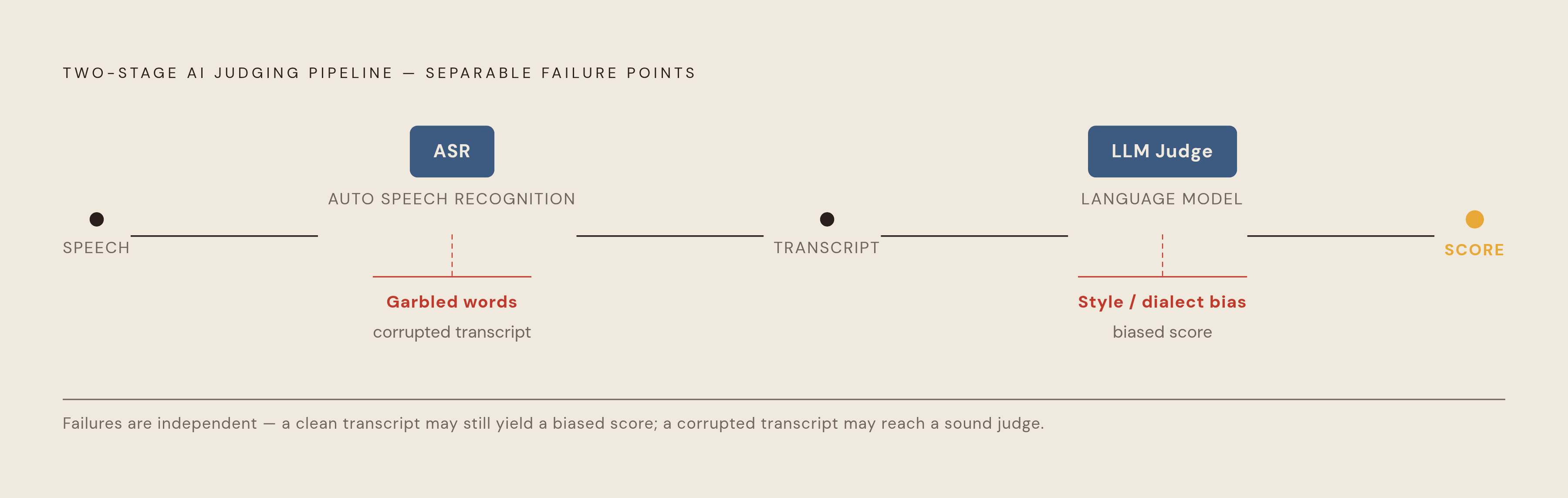
The two layers fail in different ways. A clean transcript can still receive an unfair score, and a biased judge can still be handed a transcript so corrupted that the fairness of its reasoning is almost beside the point.
Researchers behind A Cross-Community Agenda for Speech AI describe exactly this kind of setup as a "chained pipeline, where an ASR module transcribes speech to text, an LLM operates on that text." Once speech becomes text, some of that identity is stripped out, but some of it is encoded into the errors themselves, so every step in the chain makes a social judgment as well as a technical one. That is true whether the task is customer service transcription or competitive debate.
In a debate round, these two layers do not sit side by side, they interact directly. If the ASR system mishears a word, drops a clause, or garbles a phrase, the LLM judge never sees the argument that was actually made. It scores something else: a corrupted stand-in for the speech, not the speech itself. The rest of this piece follows that distinction layer by layer, starting with where the first failure point comes from and why it is not a small technical quirk waiting to be patched.
Where ASR accent bias comes from
ASR systems recognize some accents more reliably than others, and the reason is not that certain accents are inherently harder for a machine to parse. Research into this gap finds that lower recognition accuracy for certain speaker groups cannot be explained by differences in linguistic patterns, which rules out the easy, wrong explanation that some accents are just "messier" speech. Instead, the deficiency sits in how the model represents the acoustic signal itself: the training data the system learned from did not include enough varied acoustic examples of how different accents actually sound.
That is a data problem, and data problems are choices. This is a pattern already showing up in deployed systems, not a prediction about some future risk.
A Cross-Community Agenda for Speech AI adds a sharper point about how the field tends to think about fixing this. Sorting speakers into boxes and checking performance box by box still leaves room for everyone who does not fit neatly into one of the boxes.
It would be reasonable to expect this gap to close on its own as ASR keeps improving year over year, and in a narrow sense, it is closing. The fix exists in research labs. It has not reached most of the pipelines debaters depend on right now, which makes this an active problem today, not a historical one.
What a corrupted transcript does to an LLM judge's evaluation
When ASR mangles a transcript, the LLM judge downstream is grading a distorted argument, not a weak one, and it has no way to tell the difference between the two. The judge has only the text in front of it, and nothing in that text flags which parts are the debater's actual reasoning and which parts are transcription noise.
Scoring a debate speech well requires weighing two different things at once: the strength of individual arguments taken one at a time, and the overall persuasiveness of the speech as connected discourse. A garbled transcript damages both. A single mangled sentence can break the local logic of one claim, and it can also break the thread connecting that claim to the ones before and after it, so the judge loses the throughline of the whole speech, not just one point in it.
The effect stacks. Research on dialectal toxicity detection, published at EMNLP in 2025, found that LLMs are sensitive to dialectal shifts: the same content, presented in dialectal form versus standard form, can produce a different judgment from the model. The researchers identify aligning LLM predictions with human judgment across language varieties as the hardest unsolved part of this problem. That sensitivity does not wait for a clean dialectal transcript to show up. Even a transcript only partially shaped by dialect, after ASR has already altered some of it, can shift what the judge decides.
A debater sitting on the other side of a low score from this process has almost no way to see where it went wrong. The written decision reflects whatever the judge read, but the debater does not automatically know whether that text matched what was said. That gap, between what was spoken and what was scored, makes the case for transparent decision records later in this piece.
The LLM judge's own biases, independent of what the ASR hands it
Even a transcript rendered with perfect accuracy still passes through an evaluator with its own systematic tendencies, and some of those tendencies disadvantage speakers whose style sits outside whatever counts as standard in the judge's training data. This layer of bias exists whether or not ASR did its job well, which is the reason it needs its own accounting separate from anything discussed above.
Researchers studying LLM-as-a-judge systems split the biases into two families. The other family is specific to the act of judging a task: position bias, style bias, verbosity bias, and authority bias. For a debater whose spoken style doesn't match the register an LLM has learned to associate with strong argument, style bias is the one that matters most directly. It is the mechanism by which a clear, well-reasoned point delivered in a non-dominant accent or dialect can read to the model as less polished, independent of its actual content.
A 2025 study published in PNAS on AI-to-AI evaluation found that when AI systems evaluate other AI output, patterns of systematic favoritism appear that cannot be explained by the quality of what's being evaluated. An LLM judge and a human judge can reach opposite verdicts on the identical speech, with the LLM penalizing the dialectal form of the argument.
Transparent scoring rules and multi-model panels reduce the risk
Waiting for ASR training data to improve is not the fastest route to fairer outcomes. The design of the judging system itself, specifically what the rubric demands and how many independent models weigh in on a given speech, is the lever that can be pulled today.
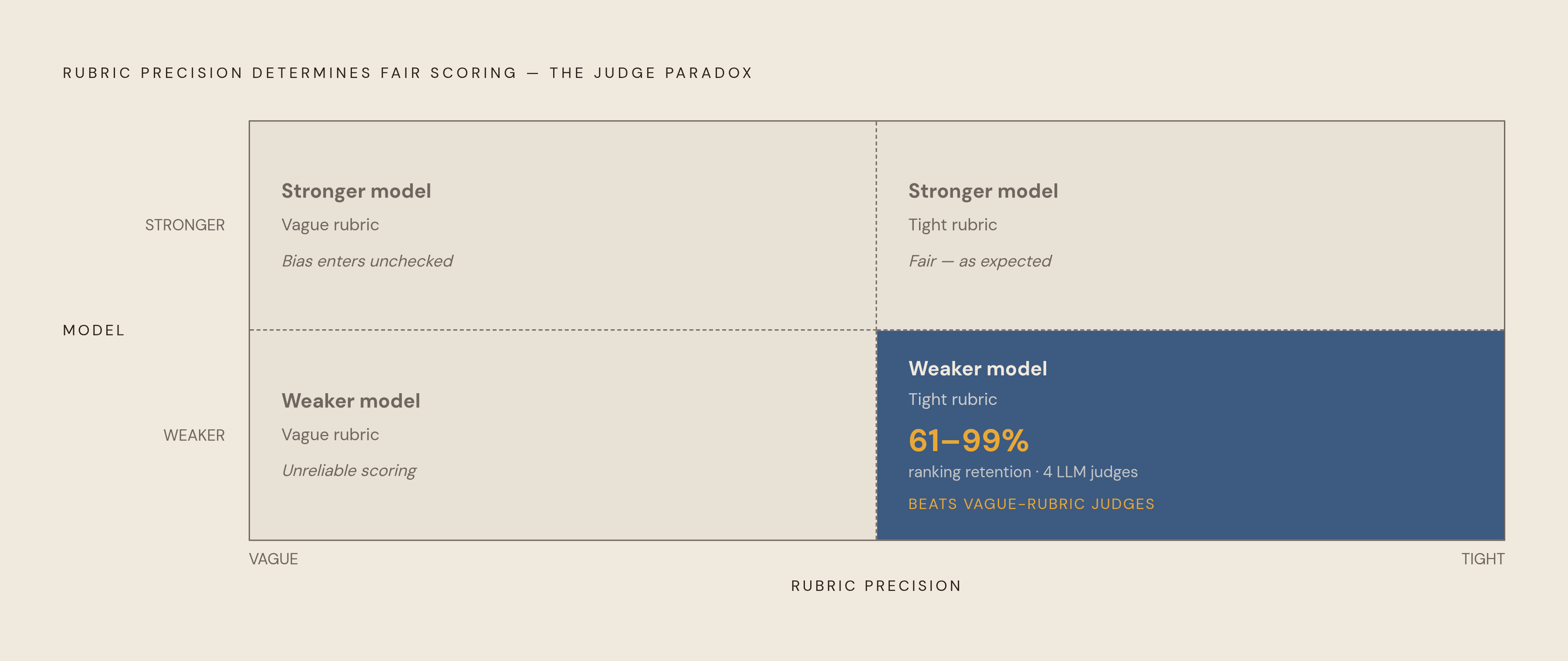
One of the more surprising findings in recent evaluation research has been called the "Judge Paradox": a weaker model given a strong, precisely specified rubric will outperform a stronger model working from a vague one. The rubric, not the raw sophistication of the model reading it, ends up determining how fair the outcome is. That has a direct implication for debate scoring: if the criteria for "clarity" or "persuasiveness" are written loosely enough that accent and coherence can blur together, even the most capable model will blur them. Written tightly enough that clarity means the structure of the reasoning, not the sound of the delivery, a far less sophisticated model can score it fairly.
Research out of Stanford, Oumi.AI, and NYU has gone further than rubric design, building a framework called average bias-boundedness (A-BB) that offers something closer to a mathematical guarantee. The framework, described in the paper Towards Provably Unbiased LLM Judges via Bias-Bounded Evaluation, formally bounds the harm that a measurable bias can do to a judge's output, and it does this even when the underlying causes of that bias are tangled together or not fully understood. Tested on the Arena-Hard-Auto benchmark across four different LLM judges, the method held onto 61 to 99 percent correlation with the original rankings even when formatting and schematic biases were deliberately introduced<sup>3</sup><sup>2</sup><sup>1</sup>. That is evidence that provably fair LLM judging is an active, working research direction, not an aspiration sitting in a white paper.
Multi-model panels offer a second, complementary structural fix. Instead of one LLM delivering a single verdict, several models interact through debate, discussion, or voting before a score is finalized. The logic mirrors how human judging panels work: several evaluators challenging each other's read of a speech tend to land closer to a fair outcome than any one evaluator working alone. None of this erases the risk a single-layer failure introduces. A tight rubric and a multi-model panel still start from whatever transcript the ASR system handed them, and if that transcript is already corrupted, the panel is debating a distortion with more rigor, not less distortion. But a published rubric and an evaluator panel are concrete design choices a platform can make now, and they shrink the space in which bias at either layer can operate unchecked.
What debaters with non-dominant accents can do
Understanding this two-layer architecture is itself a competitive skill, not just background knowledge. Knowing which layer failed in a given round, transcription or evaluation, is the first real step toward making an effective appeal, because the fix looks different depending on where the breakdown happened.
At the transcription layer, a few things sit within a debater's control that do not touch their accent. Articulation rate, microphone quality, and the acoustic environment around a speaker all affect how accurately ASR renders their words. Cutting background noise and pacing delivery so the ASR model has more clean signal per syllable are low-cost adjustments, and they work on the acoustic input, not on the voice itself.
At the evaluation layer, structuring a speech with explicit signposting, numbered points, clear transitions between them, and a visible claim-warrant-impact sequence for each argument, reduces how much the judge has to infer from style alone. The structure of the reasoning becomes legible on the page even when the register of the delivery differs from whatever the model's training data treats as standard.
The most direct diagnostic a debater has is the judge's own written decision, read back against what was actually said. A decision quoting or clearly built on garbled text points to a layer-one failure, an ASR breakdown. A decision that penalizes a speech for lacking clarity despite a transcript that reads coherently points to layer-two bias, a judgment problem. A Cross-Community Agenda for Speech AI makes the underlying case for why this distinction matters: speech AI systems, in the authors' account, work from an incomplete model of communication and an incomplete model of identity, and the metrics built on top of those models often measure the wrong thing. A debate score labeled "clarity" that actually measures how closely a voice matches a dominant accent is measuring something other than what it claims to measure, and a debater who can show that conflation in a written decision has real grounds to appeal it.
Practice rounds against AI opponents serve a similar diagnostic purpose before a scored round is on the line. Adjusting articulation or sentence structure to work around a biased pipeline is a tool for operating inside a system that still needs to change, not a substitute for that change.
Requirements for a Fair AI Judging System for Accent-Diverse Speakers
Accent fairness in AI-judged debate belongs in the baseline design of any platform claiming its scores can be trusted, not bolted on as a later feature. A verdict that cannot be checked against what a debater actually said functions as a guess shaped by whichever speech patterns the training data happened to favor, and no platform should present a guess as a verdict.
The production pattern taking shape for responsible AI evaluation by 2026 is a hybrid one: automated scoring handles what can be measured consistently, LLM panels take on the dimensions that require actual reasoning, and human review sits available for cases flagged as uncertain or formally appealed. For accent-diverse student communities specifically, that human backstop functions as an equity requirement. It is not optional polish layered on top of an otherwise complete system.
The Bias-Bounded Evaluation framework points toward a future in which bias guarantees are something a platform can state with measurable confidence, not just promise in good faith: that a system's average-case bias does not exceed some specified, published threshold. The 2025 ACM FAccT study on synthetic voice technology calls for exactly this kind of inclusive design and regulation, offering developers, policymakers, and institutions a concrete basis for building equitable and socially responsible speech systems. That call applies directly to any debate platform running a voice-to-text pipeline at scale, especially given that position bias alone, tied to nothing more than the order in which questions or arguments are presented, has been shown to degrade evaluator agreement by as much as 25 percentage points. A trustworthy system publishes its scoring rubric before the round begins, grounds every decision in what was actually said rather than a paraphrase the model inferred, runs evaluation through a panel of independent models rather than a lone judge, and keeps a human appeal pathway open for every speaker, regardless of what accent they bring into the room.
Sources
- Towards Provably Unbiased LLM Judges via Bias-Bounded Evaluation
- Reply to Yu et al.: Datasets, human judges, and future directions for evaluating AI–AI bias
- “It’s not a representation of me”: Examining Accent Bias and Digital Exclusion in Synthetic AI Voice Services
- Dialectal Toxicity Detection: Evaluating LLM-as-a-Judge ...
- A Cross Community Agenda for Speech AI
- UXBench: Benchmarking User Experience in AI Assistants
- Judging the Judges: A Systematic Evaluation of Bias Mitigation Strategies in LLM-as-a-Judge Pipelines
- Judging LLM-as-a-Judge: Concerning Rubric Artifacts in LLM-based Automated Text Generation Evaluation