Code-Switching Mid-Debate in Indian English Contexts
Speakers who switch languages mid-argument gain rhetorical power, not lose it.
Code-switching in Indian English debate is not a lapse into informality or a sign that a speaker has run out of words. It is a deliberate rhetorical tool that signals identity, builds alignment with an audience, and shifts the register of an argument in ways a single, unbroken language cannot.
Code-switching in Indian English is a feature of the language, not a flaw in the speaker
Ambawade (2026) makes the case: code-switching and code-mixing in Indian English are built into the language itself, not symptoms of a speaker who hasn't fully mastered English. They reflect social identity, cultural loyalty, and the kind of efficiency that comes from living every day inside more than one language. That framing matters because it changes what a debate coach should be looking for when a speaker shifts languages mid-argument: not a gap to be closed, but a choice to be read.
Two different things get lumped together under the term "code-switching," and the difference matters for anyone trying to use it on purpose. One kind happens between utterances or discourse chunks, triggered by a change of topic, audience, or setting. It's visible, and a speaker usually chooses it. The other kind happens inside a single utterance, down at the level of a sentence, a word, or even a morpheme. Bontempo (2025) calls this second kind code-mixing, and it runs on autopilot, revealing speaker-internal attitudes in moments the speaker may not even notice. A debater who knows which kind is happening in their own speech can start deciding when to use the first kind and when to guard against the second.
None of this is a fringe phenomenon confined to casual conversation. India runs on 22 official languages and a population that moves between them daily, so code-mixed speech is the ordinary way a huge share of the country's debating audience actually talks, a point Das and colleagues make in their Indi-RomCoM work. Someone might object that formal debate rounds demand English and English only, which would make any switch a liability. But formal settings only fix English as the base language of the round. They don't stop switching from happening, they just raise the cost of getting it wrong, and that's precisely why a speaker who understands code-switching strategically has more control in those rounds, not less.
Identity, prestige, and emotional register: what the switch signals
Every time an Indian English speaker moves between languages, you get two separate kinds of social meaning available at once. English carries prestige and the weight of academic authority. Regional languages carry emotional closeness and a sense of shared identity. A switch doesn't choose between these meanings so much as activate whichever one the speaker needs at that exact second, and that double availability is what gives the move its force.
You can see this clearly in Tamil Nadu, where English works as a lingua franca alongside Tamil in daily public life. Bontempo's 2025 study of English-Tamil code-switching in 35,650 romanized YouTube comments found that positive utterances carried a significantly higher proportion of English, 34.3 percent, than negative utterances, which sat at 24.8 percent. Mixed-sentiment utterances, the comments that carry both positive and negative content at once, showed the highest rate of language-switching once you control for comment length. Emotional tone drove which language got used and how much of it: English tracked approval, and the regional language tracked something rawer.
The consequence for a debater is that no switch is ever just a stylistic flourish. The instant a speaker moves from English into a regional language or back again, that move says something about how the speaker sees the audience, the opponent, or the claim on the table at that moment. Treating that as background noise means missing half of what the speech is doing.
The four functions code-switching performs in sociopolitical spoken debate
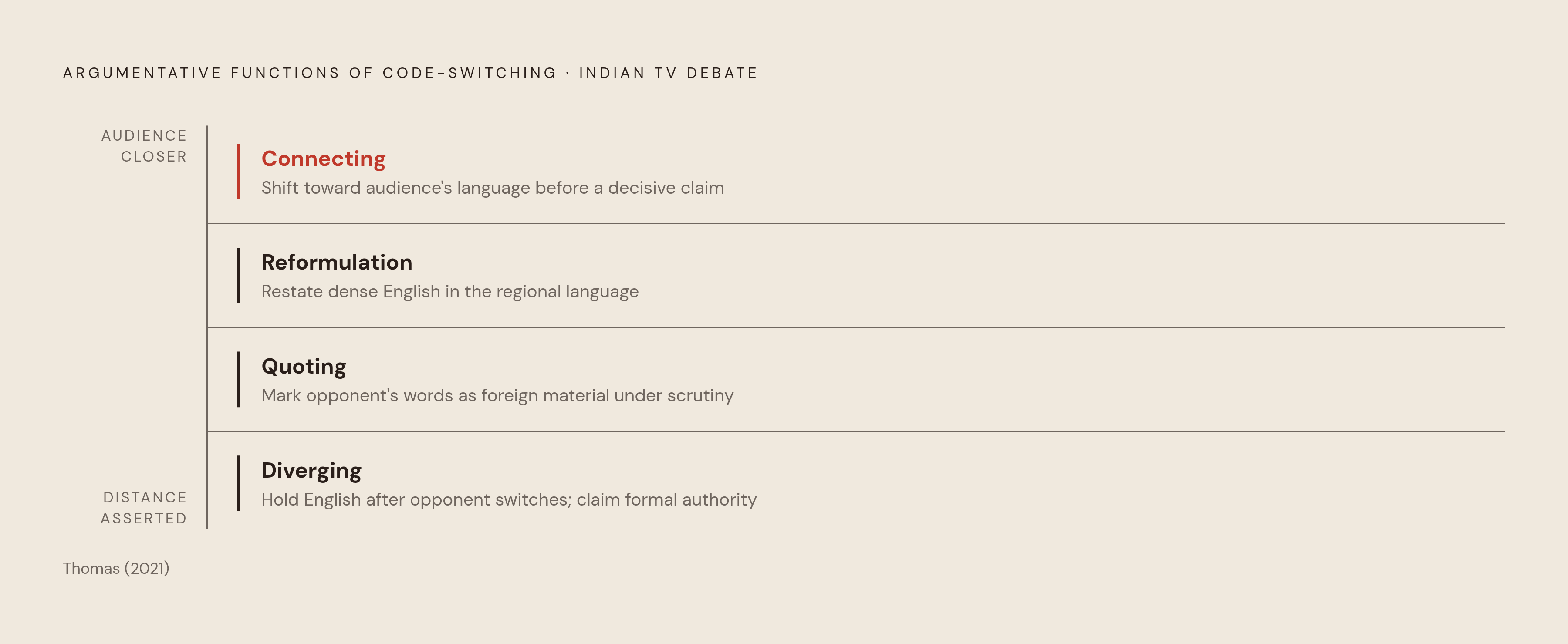
Thomas (2021) studied Indian English television talk shows, a genre of sociopolitical speech structurally close to live debate, and found that code-switches there did real argumentative work: reformulating points, quoting, connecting with an interlocutor or pulling away from one, and generating emphasis. Each one shifts the register the argument is running in, and each has a direct equivalent a debater can use on purpose.
Reformulation means taking a dense English argument and saying it again in the regional language so an audience that's been processing at a distance can catch up. That's a comprehension move made in the open, not a sign the speaker is backing off the claim.
Quoting an opponent's words by switching into Hindi or another language creates distance between the speaker and what's being quoted. The switch marks the opponent's words as foreign material held up for inspection.
Returning to English right after a Hindi quotation, Thomas (2021) notes, carries real emphatic weight, pulling focus back to the formal register of the argument and signaling that accountability has resumed.
Connecting works the other way: switching toward the audience's own language mid-speech signals shared ground and invites the room to align with the speaker before a decisive claim lands.
Diverging means staying in English even after an opponent has moved into a regional language. That refusal to follow signals formal authority, and it denies the opponent the chance to pull the whole exchange onto their preferred rhetorical terrain.
Five functions, each doing something different, each available to a speaker who knows to look for the moment that calls for it<sup>3</sup><sup>1</sup>.
Hinglish as the matrix: the debate register where switching is the default mode
In a large share of Indian English debate contexts, English isn't just the base language with a few words borrowed from elsewhere. In that register, code-switching is the medium the argument travels through from start to finish.
Sheth and colleagues' 2026 survey of code-switched natural language processing, out of IIT Gandhinagar, names Hinglish as one of the most studied code-switched varieties anywhere in the world, and that shows how far this mixed register has spread through digital communication and everyday speech in India. That's not a niche research curiosity. It tells you the register a huge number of debate audiences are already fluent in, whether or not a judging rubric acknowledges it.
Where both debater and audience live in Hinglish day to day, insisting on pure English or pure Hindi delivery doesn't read as more rigorous. It reads as put on. The register itself carries information about how the speaker sees their own position and how they want to be seen. Hinglish also follows its own internal grammar: speakers switch at predictable points governed by consistent rules, not at random. A judge or opponent who waves it off as sloppy or informal has misjudged what is, in practice, a structured and demanding way of speaking.
The real liability: unconscious switching versus switching you control
The advantages described so far depend entirely on one condition: the switch has to come from argumentative intent, not from running out of words. If a debater switches languages because the right English term isn't there, the move stops signaling anything useful, and it shows the judge exactly where the argument's construction is thin.
Switching too much, or switching without a plan, costs a debater practice at building fluency in the register the round actually runs on, and it can leave a speaker leaning on their first language right at the moment English precision is what's needed. The argument gets harder to follow, not easier, which is the opposite of what a well-placed switch is supposed to do.
The risk concentrates at the sub-utterance level, the intra-discursive code-mixing Bontempo (2025) describes as largely unconscious. A speaker who switches mid-word or mid-clause without noticing has no way to control what signal that switch is sending, because they don't know they sent one. In practice, the test is where the switch lands: a switch placed right before or after a key claim usually reads as deliberate framing or emphasis, while a switch that lands in the middle of building a warrant usually reads as a word search.
None of this argues for suppressing the habit. The fix is to become aware enough of the switch to choose it: name the function needed in the moment, whether that's emphasis, connection, quotation, or reformulation, then make the switch land on purpose at a natural discourse boundary rather than letting it happen wherever processing strain happens to hit.
The judge problem: how monolingual evaluation systems misread code-switched arguments
Mastering intentional switching solves half the problem. Whoever is scoring the round determines the rest. AI judging systems trained mainly on English-only debate transcripts risk reading a mid-speech code-switch as a breakdown in coherence rather than a rhetorical move, which would penalize exactly the kind of deliberate, skilled switching this piece is arguing debaters should develop. Sheth and colleagues (2025) confirm that most large language models still struggle with mixed-language input, and that the resulting evaluation bias gets in the way of deploying these models fairly in multilingual societies like India's.
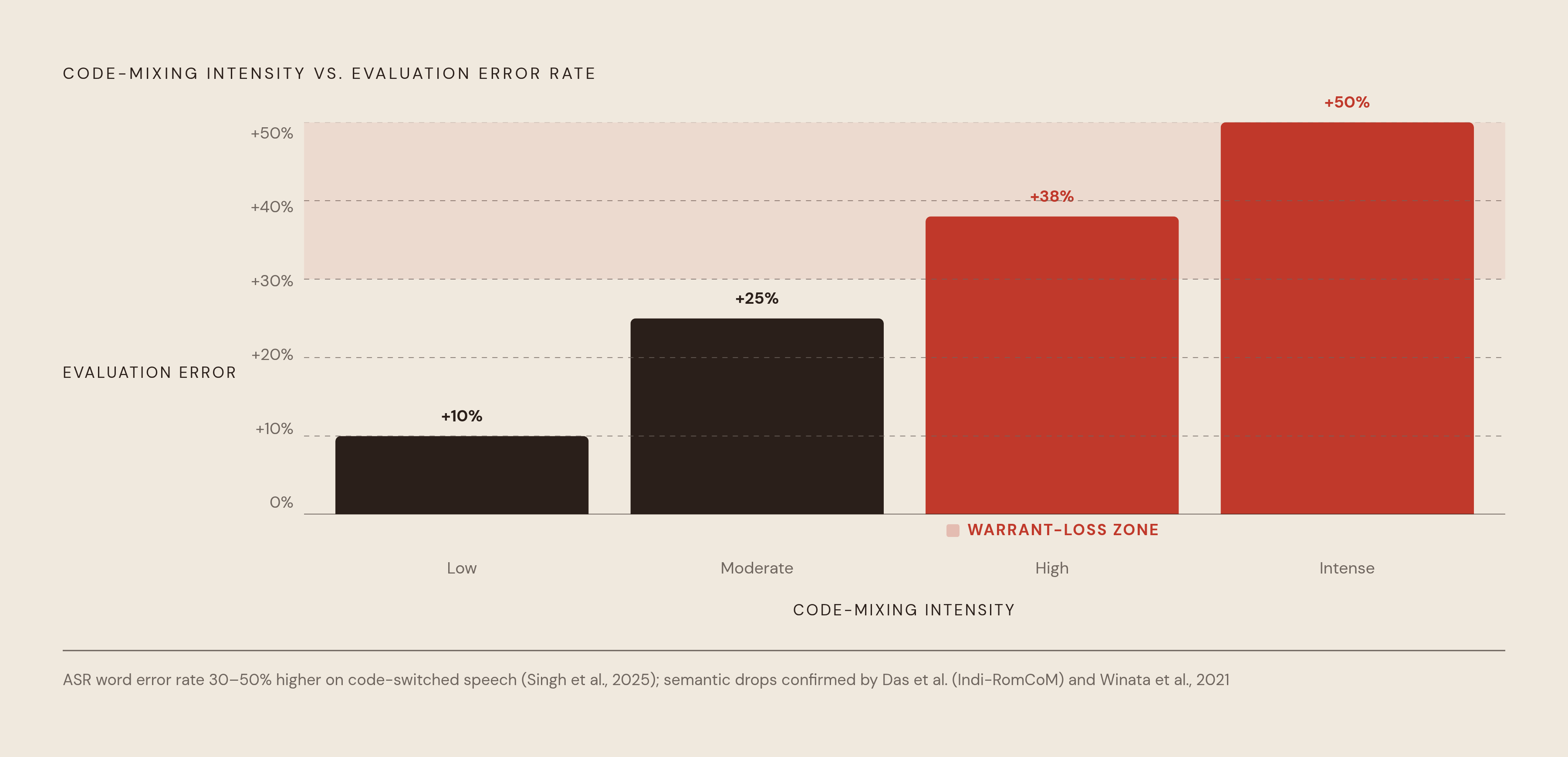
The technical numbers back this up. Singh and colleagues (2025) found that monolingual automatic speech recognition systems see word error rates climb by 30 to 50 percent on code-switched speech. Separately, Winata and colleagues (2021) found that even multilingual models show drops in semantic accuracy on mixed-language input. Put together, a judging system relying on transcription or automated comprehension of spoken code-switched argument can lose track of a warrant entirely because the system never registered what was said.
Das and colleagues' Indi-RomCoM benchmark shows the same pattern from another angle: large language model performance drops steadily as code-mixing intensity rises, and tasks that require detecting what was actually said or claimed suffer more than tasks that require following the reasoning. An AI judge can track the logical structure of an argument correctly while still missing whether a specific claim, delivered mid-switch, was made. Human judges face a version of the same limit: a warrant delivered in Tamil or Hindi to a panel that only follows English is, for the purposes of that panel's decision, a warrant that was never made.
The working rule this produces is straightforward. High-stakes claims and core warrants belong in the matrix language, English, where the panel or the model is guaranteed to register them. You can still use code-switching for framing, emphasis, and connecting with the audience. It should not carry the load-bearing logical structure of the argument, because that's the part a mismatched judge or an under-trained model is most likely to drop. Fair judging of code-switched debate requires published scoring criteria that account for multilingual delivery, and for AI judging specifically, clear rules about how switches get handled, set before the round starts.
Getting to that level of control takes reps, and the right kind of reps trains cross-register fluency in a way raw repetition alone does not. Steel-manning the opposing argument in the regional language, then rebutting it in English, trains the cross-register fluency that makes a switch feel chosen. Practicing against an AI opponent lets a debater stress-test argument structure across registers at a volume no human practice partner's schedule could match, and without the emotional pressure of a live round, it's easier to isolate the switching habit and adjust it on purpose. Short, focused sessions aimed at a specific skill, in this case switching function rather than switching frequency, beat occasional marathon sessions. Three or four focused rounds a week, each followed by a real debrief, builds the habit faster than a single long session ever could. Live rounds against real opponents add something AI sparring can't fully reproduce: an opponent who will exploit a switch that reads as a stumble, which is exactly the pressure that forces a debater to make every switch count.
Sources
- Code-Switching and Code-Mixing in Indian English by Miheer Ambawade :: SSRN
- Beyond Monolingual Assumptions: A Survey of Code-Switched NLP in the Era of Large Language Models across Modalities
- Indi-RomCoM: Code-Mixed Benchmark for Evaluating LLMs on Romanized Indic-English Instructions
- (PDF) Code-Switching in Spoken Indian English: A Case Study of Sociopolitical Talk
- EnTaCs: Analyzing the Relationship Between Sentiment and Language Choice in English-Tamil Code-Switching
- An Overview of Indian Spoken Language Recognition from Machine Learning Perspective