Debate Terminology Across British and American English
Identical debate terms carry opposite meanings across British and American formats.
British and American English share a grammar backbone but diverge on hundreds of words, and in debate the stakes of that divergence are higher than in everyday conversation. The misunderstood word is often a procedural or structural one, attached to a role, a rule, or a stage of the round. Get it wrong and the argument doesn't just wobble. The round itself shifts underfoot.
Why the same words mean opposite things in British and American debate
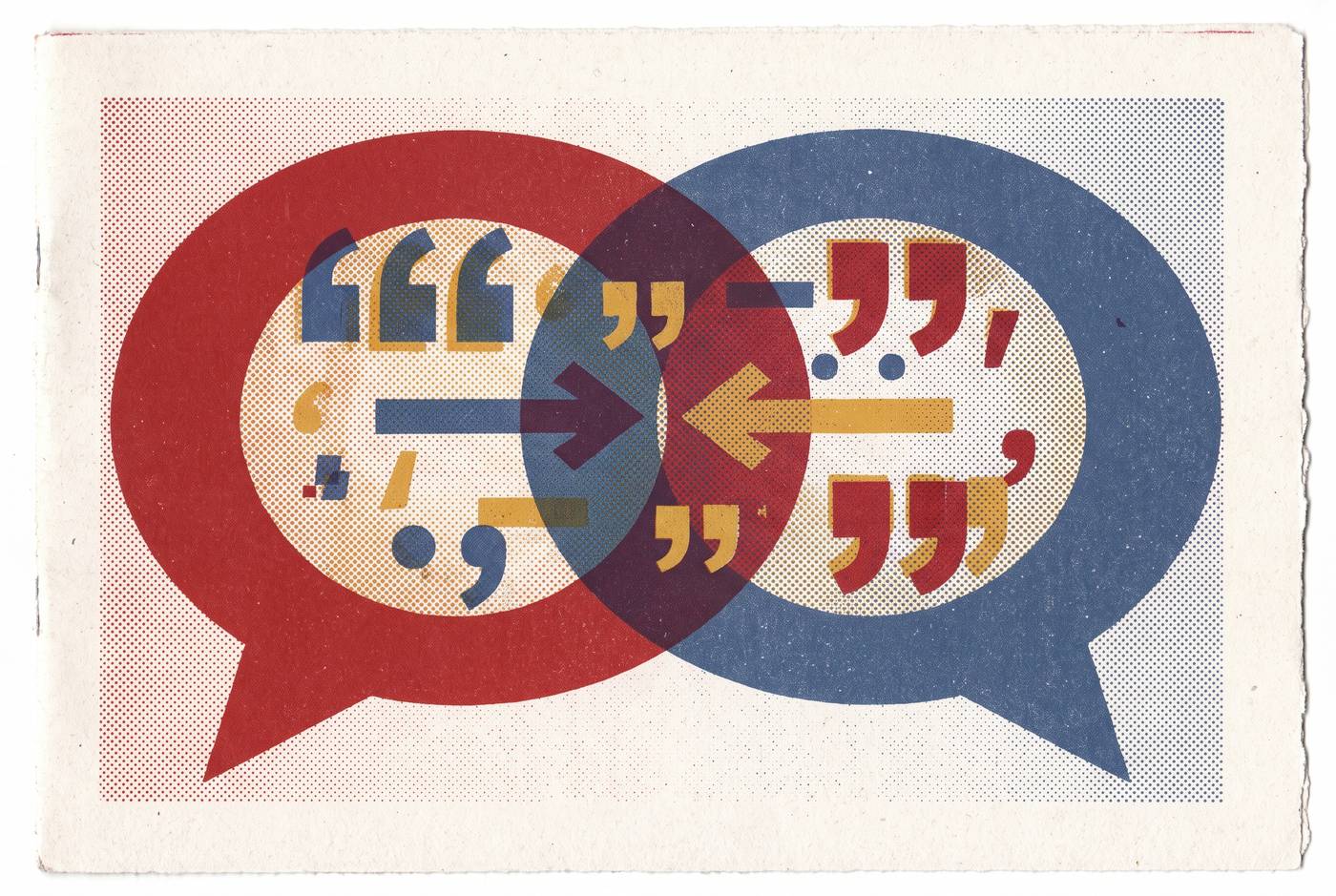
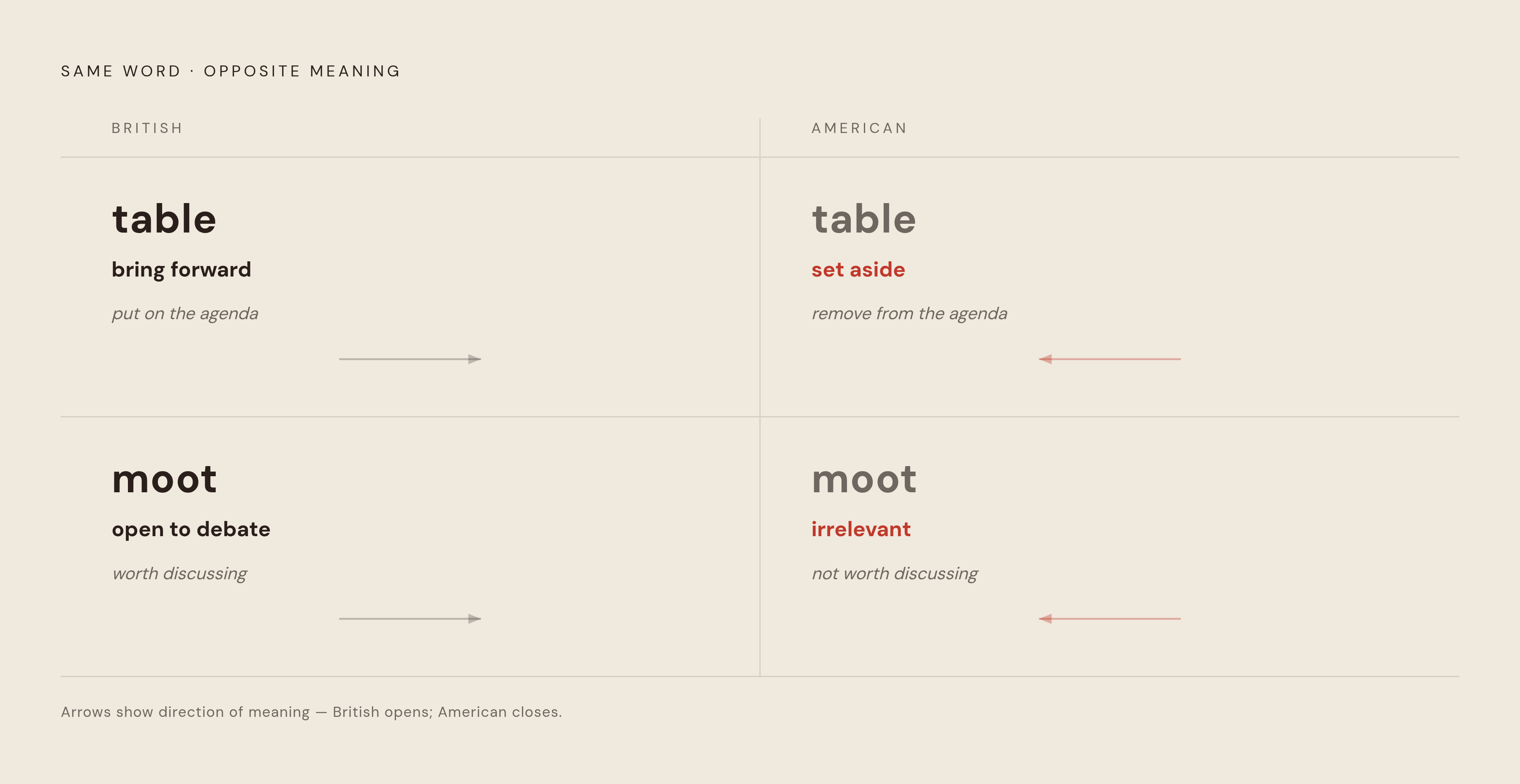
The clearest illustration sits inside a single verb: to table. In British English, to table an item means to open it for discussion, to bring it forward. In American English, the same verb means to remove an item from discussion, to set it aside or end it. In a formal setting, the same sentence lands the opposite way depending on which tradition the speaker works in. A second example follows the same pattern. A moot point, in British usage, is one that remains open to debate: unresolved, worth arguing. In American usage, a moot point has no practical significance and can be dismissed. A debater who calls an opponent's argument "moot" lands a very different blow depending on which room they are in.
These are not edge cases. Both words appear in formal debate settings, and both are borrowed directly from legal and parliamentary vocabulary, the register where precision matters most. When the misunderstood word is also the word that governs procedure, the cost of divergence stops being a matter of style and becomes a matter of structure.
How the split between British and American English happened, and why debate formats inherited it
The divergence traces to the 1600s, when British colonists carried English across the Atlantic and the two varieties then developed in relative isolation. Noah Webster pushed the divide further in 1828 when he published a dictionary that deliberately simplified British spellings to give American English a distinct identity. That reform explains why Americans write "color" rather than "colour" and "defense" rather than "defence," and it also points to something deeper: the two traditions developed different instincts about formality and naming conventions.
Debate formats inherited this split directly. Competitive parliamentary debate formalized in 19th-century England, and it was built on procedural vocabulary that had been developing since the 18th century in the House of Commons. When American debate grew, it did so alongside the American English that Webster had helped distinguish. The result is that British and American debate formats share a lineage but developed parallel vocabularies. Many of the same concepts exist in both traditions under different names. Some role names look identical but carry different structural meanings. And a handful of everyday English words that cross over into debate mean opposite things.
The structural vocabulary of British Parliamentary — the international format built entirely on Westminster naming
British Parliamentary debate, also called Worlds Style, is the format of the World Universities Debating Championship and the European Universities Debating Championship, and its terminology is derived wholesale from the House of Commons. The format consists of four teams of two speakers, with the two sides called the Government and the Opposition. The Prime Minister opens for Opening Government and defines the motion. The Deputy Prime Minister extends the case and responds to the Leader of Opposition. On the other side, the Leader of Opposition opens the opposition's case and challenges the government's framing, while the Deputy Leader of Opposition extends the opposition case. For the closing teams, the Member of Government speaks first for Closing Government and must add a genuine new argument, called an extension, not made by Opening Government. The Member of Opposition adds the parallel extension for Closing Opposition. The Government Whip then summarizes the entire debate from the proposition's viewpoint, defending both proposition teams while introducing no new arguments, and the Opposition Whip performs the equivalent summary for the opposition.
The procedural vocabulary around these roles is equally parliamentary. The topic is called the motion, not the resolution, and motions are framed as This House Believes or This House Would, as in This House Would Support Assisted Suicide. Motions are announced shortly before the debate, and during prep time debaters may consult only their partner and printed materials. Internet and electronic resources are prohibited, with the exception of electronic devices used exclusively as dictionaries. The presiding adjudicator is addressed as Mister Speaker or Madam Speaker, and all remarks are directed to the Speaker rather than to the opposing team, a rule borrowed directly from House of Commons procedure.
The format's most distinctive mechanic is the Point of Information. After the first minute and before the last minute of each seven-minute speech, any speaker from the opposing benches may stand and offer a brief question or challenge of fifteen to twenty seconds maximum. The speaker holding the floor may accept or decline, and each speaker is expected to accept one or two POIs per round. The mechanic has no direct equivalent in American formats. Finally, BP ranks rather than crowns a single winner: one team places first, one second, one third, one fourth, and those ranks convert to points, commonly 3 for first, 2 for second, 1 for third, and 0 for fourth, which determine tournament standings.
How American Parliamentary formats name the same structure differently — and where the terms genuinely diverge
American Parliamentary debate developed its own parallel vocabulary, one that overlaps with BP in places and departs from it in others. The two traditions share a lineage but are not interchangeable. In American Parliamentary debate, associated with APDA, the format is two versus two: two speakers on the Government team, the Prime Minister and Member of Government, and two on the Opposition, the Leader of the Opposition and Member of the Opposition. The role titles Prime Minister and Leader of the Opposition appear in both traditions, but in APDA they attach to a two-team structure rather than BP's four-team structure. A debater carrying BP experience into APDA must recalibrate what their role covers.
A deeper structural difference follows. In APDA, the Government team sets the resolution itself, running any case they choose. That creates a strategic layer around definitional control and burden of proof that BP's pre-announced motions do not produce in the same way. Even the topic word shifts: "motion" dominates British formats, while "resolution" dominates American ones. Both words appear across formats, but defaulting to the wrong one immediately signals which tradition a debater was trained in. American formats outside Parliamentary add further naming layers. Team Policy debate, the oldest format still practiced in American high schools, calls the proposition side the Affirmative and the opposition the Negative, terms that do not appear in British formats. Public Forum debate uses Pro and Con, with a coin toss determining which team chooses their side or speaking position. Points of Information have no direct American equivalent. American Parliamentary formats do not include a standing-interruption mechanic with the same procedural rules, so a BP-trained debater entering an American round finds one of their most practiced skills has no designated outlet, while an American debater entering a BP round encounters POIs as an unfamiliar pressure they have not drilled for.
The words that look shared but aren't — procedural terms with divergent or reversed meanings
The most consequential terminology gap is not between terms that are obviously different, like Government versus Affirmative, but between terms that look shared and aren't. These are the cases where a debater assumes mutual understanding and receives the opposite of what they intended. Motion and resolution form the first such pair. Both words appear in both traditions, but motion is the operative term in BP and resolution in American formats. A debater who says "the motion" in an American round, or "the resolution" in a BP round, is immediately identifiable as an outsider, and in written rules and judging criteria the terms may carry specific procedural weight that does not transfer.
Table and moot are the reversed meanings. In British parliamentary usage, to table an item means to bring it forward for discussion. In American usage, it means to set the item aside, to end or postpone discussion. In a cross-Atlantic debate context, saying "let's table that" produces opposite expectations. Moot follows the same reversal: a British moot point remains open for debate, while an American moot point has no practical relevance. Calling an opponent's argument moot in a mixed room is either a strong challenge or an admission of irrelevance, depending on who is listening. Two further terms diverge without reversing. In BP, the Whip is a specific speaker role with defined functions: summary, no new arguments. In everyday British political English, a whip is also the parliamentary enforcer who manages party discipline, so the same word carries both meanings in the British context. In American debate, neither the role nor the political connotation translates cleanly, and the term is not used in the same way. Extension operates similarly. In BP, an extension is a specific technical requirement: the Closing Government team must introduce a genuinely new argument rather than repeat Opening Government's case. The word in American debate contexts does not carry this precise technical weight and may be used more loosely.
What these differences mean for debaters who cross between formats or compete internationally
The terminology gap matters most at the point of format transition: an American collegiate debater entering a WUDC-style BP tournament, a British debater competing at an American university, or a debater joining an international online platform where both traditions appear in the same room. The structural role names create immediate confusion at the draw or pairing stage. A debater who does not know that "Member of Government" in BP carries different responsibilities than "Member of Government" in APDA may prepare the wrong kind of speech, misunderstand their obligation to extend rather than repeat, or fail to take POIs because they do not know the mechanic exists.
The motion-versus-resolution divide compounds in judging. A judge trained in one tradition may apply criteria, such as how a topic is framed or what counts as a valid definitional challenge, that the debater's tradition treats differently. If the scoring criteria use one term and the debater uses the other, the disconnect can look like a content error rather than a vocabulary one. Online debate platforms bring both traditions into contact without the mediation of a shared coaching staff or a pre-tournament briefing, which makes it more likely, not less, that a debater encounters a round with different term conventions and no one present to clarify them. AI judging built on transparent, pre-published criteria can reduce that confusion because the scoring dimensions and terminology are made explicit before the round begins rather than assumed to be shared. That is a structural advantage over human judging panels whose format assumptions may remain implicit.
How to orient yourself quickly when you enter an unfamiliar debate tradition
The fastest orientation is to identify two things at the start of any round in an unfamiliar format: what the topic is called and what the sides are called. Motion or resolution tells you which tradition governs the room. Government and Opposition, Affirmative and Negative, or Pro and Con tells you which vocabulary the judge and opponents will expect. Taken together, those two data points locate the format. Before any cross-format tournament or platform, map your role title to its equivalent in the other tradition. Specifically, check whether your role carries an extension obligation, as it does for Closing Government in BP, that your home format does not require, and check whether a mechanic like POIs will be present that your training has not prepared you for.
For the terms with opposite meanings, table and moot, the practical rule is to avoid them in cross-tradition settings unless the audience is certain. Paraphrase instead: "I want to set this aside for now" or "this question is still open" removes the ambiguity without sacrificing the point. Debating out loud against opponents from different traditions, whether in a live one-on-one match or against an AI opponent on a platform where both formats are represented, is the fastest way to encounter these divergences in practice rather than learning them abstractly. An AI judge that cites what was actually said and scores against published criteria gives a debater post-round evidence of where a term choice or structural move landed differently than intended. The broader skill being developed is format fluency: the ability to read a new debate environment quickly and adjust not just arguments but vocabulary, structural expectations, and procedural instincts. That fluency is a version of the same skill that makes someone a better debater in any tradition: the ability to understand the frame an opponent and judge are working within and argue inside it deliberately.