Judging Clarity When Accented Speech Uses Non-Standard Stress Patterns
Judges must distinguish argument structure from unfamiliar stress patterns to score fairly.
Judging clarity in accented debate speech requires separating accent identity from the work that stress and rhythm do. The defensible standard is whether delivery makes the argument’s structure audible. That distinction gives debaters a clear goal for practice and helps human and AI judges score how well they understood the speech without marking it down for sounding unfamiliar.
Why clarity in spoken debate is a prosodic question, not an accent question
A debater presents a sharp argument, but the emphasis keeps landing on connective words. The reasoning is sound on the page. In speech, however, the listener struggles to distinguish the main proposition from the language joining it to the next thought. That is a problem of stress placement. A strong accent can remain fully intelligible, while misplaced emphasis can obscure an otherwise well-organized case.
Prosody is the organization of stress, rhythm, pausing, and pitch. These features are suprasegmental, meaning that they operate above individual sounds to signal importance, thought boundaries, and whether a speaker is stating a claim or qualifying it. The musical distinction is useful here. Individual sounds are the notes, while emphasis and rhythm supply tempo and melody. Correct notes alone do not make a performance easy to follow.
Misplaced word stress can make a familiar technical term sound unfamiliar, while misplaced sentence stress can make a supporting detail sound like the main point. An Iowa State University pronunciation textbook reports that instruction in stress and rhythm improved comprehensibility during spontaneous speech, whereas instruction in individual sounds alone did not. Both groups improved on controlled tasks such as reading aloud. Transfer to unscripted speech makes stress management especially relevant to live argument.
What a listener actually does when stress patterns are unfamiliar
Unfamiliar stress patterns require additional effort to process. That effort competes with attention to content, so a listener may struggle with delivery while interpreting the difficulty as a weakness in the argument. Lower intelligibility and higher listening effort are associated with lower ratings of warmth and competence, and processing effort can also affect credibility judgments independently of content. Listening difficulty can become a judgment about the person speaking or the quality of their reasoning.
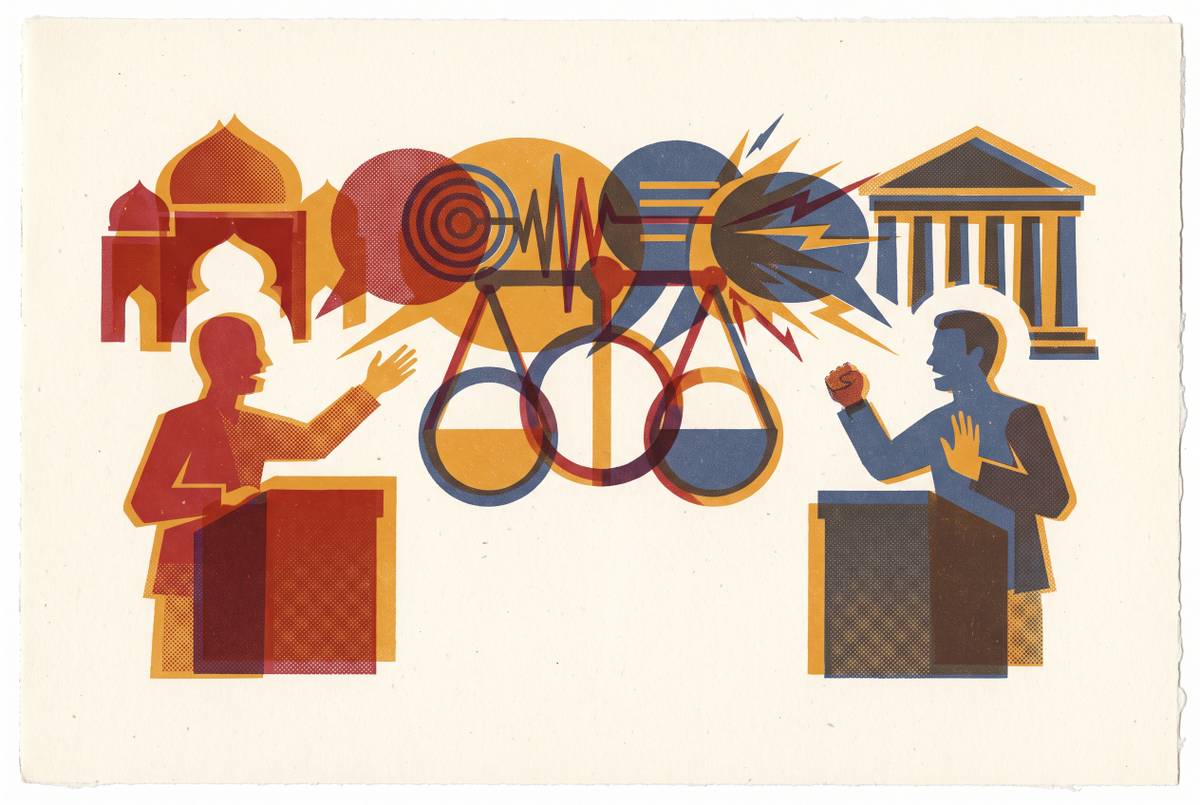
In April 2025, one of the world’s best oralists and a seven-time international debating champion quit competitive debating over adjudication he attributed to his race and accent. His debating partner said he had been forced to drop out of a tournament after an adjudicator criticized him for missing points and poor structure. The partner characterized those criticisms as fabricated. These accounts represent the speakers’ perspectives on what happened in the round. The accounts still show what is at stake, because the disputed criticism was of argument structure and did not name accent as a fault.
The processing mechanism explains how that distinction can collapse. A judge may experience difficulty following speech and then assign the difficulty to missing reasoning without separating the two. Repeated exposure offers a constructive route out. Research on exposure to non-native-accented speech finds that human listeners can reach parity in listening effort as their familiarity grows. The implication for judge training is that unfamiliarity is not a fixed property of a speaker’s delivery, and an untrained panel risks scoring its own limited exposure.
How accentism becomes a structural problem in judging panels
When panels lack training in diverse stress and rhythm patterns, the listening-effort penalty can recur across rounds. A disadvantage that begins in individual perception then becomes institutional, because the same kinds of speakers repeatedly face it. Malice is not required for this pattern. If judges keep taking unfamiliar delivery as a sign of weak organization, part of the score comes from something other than the quality of the argument.
Accentism is the stereotype-driven devaluation of speakers with non-standard accents. In professional settings, it appears in judgments about intelligence, competence, and credibility, creating pressure to modify natural speech. Amaechi-Okorie and Radeljić’s paper on AI bias and speech diversity identifies the structural equation of fluency with credibility and competence, through which atypical speech patterns become grounds for marginalization. The same logic can operate within a judging panel. A familiar delivery pattern becomes an unspoken credential rather than one possible way to communicate an argument.
That pressure can also change how debaters compete. Speakers may become more passive, deferential, or inclined to over-explain in response to expectations about how they should sound. Those adjustments can weaken their argumentative performance before claims receive evaluation on their merits. A feedback loop then takes hold. If sounding the way judges expect leads to better results, debaters learn that clarity means sounding a certain way, even though accent identity and comprehensibility can be kept separate. The educational cost is that adaptation to preference displaces attention to the actual function of delivery.
What AI judging does and does not fix about this problem
An AI judge evaluating a transcript can assess argument strength, coherence, organization, and the appropriateness of style and tone from text alone, free of the listening-effort penalty that accent or stress can impose on a human audience. That advantage has a strict condition, however. The transcript must faithfully represent the speech, because an argument lost through mistranscription never reaches the judging stage.
If transcription keeps getting non-standard accents wrong, a text-based judge may score a distorted argument without showing where the distortion came from. Direct speech processing has its own risks. Bokkahalli Satish et al.’s intersectional voice bias study finds that accent and gender interact in SpeechLLM quality-of-service disparities, including off-topic or low-effort responses. Users may not recognize that their vocal identity contributed to the service they received.
Text itself is not socially neutral either. Hofmann, Kalluri, Jurafsky, and King’s 2024 Nature paper found that dialect prejudice predicts AI decisions about people’s character and employability. This challenges the assumption that removing sound removes all accent-linked disadvantage, because dialect-linked social evaluations can remain in the language a model processes. Nor do AI models “get used to” a speaker as a trained human listener does. The case for retaining well-trained human judges with AI rests partly on that adaptive capacity, rather than on a claim that either approach is automatically fair.
How the AudioTrust and CLARITY research changes what fair AI judging requires
The AudioTrust benchmark finds that current audio models default to speech profiles associated with a dominant accent and that accent and personality traits are stronger sources of bias than age or gender. Acoustic recognition alone is insufficient, however. A system must also handle the linguistic information associated with different varieties of speech, rather than treating a dominant pattern as the universal reference.
The CLARITY framework, published by a Singapore Institute of Technology team, addresses the coupling of accent bias and linguistic bias. It combines contextual linguistic adaptation with retrieval-augmented accent prompting and was evaluated on twelve varieties of English accent. It found that generating an authentic accent takes both accent fidelity and correctly localized text. Handling sound accurately while misreading dialect-specific lexical, cultural, or argumentative framing still leaves a route to disadvantage.
Liang and Beckford Wassink’s FAccT’26 study documents the human cost of this gap. Participants across four U.S. dialect communities reported frustration, feelings of inadequacy, and internalized failure even when they knew the system was the problem. They also did unseen work through code-switching, hyper-articulation, and managing their feelings to make failing systems work. Measures of accuracy alone leave out that burden on speakers. For debate platforms and judging bodies, fairness therefore extends to what speakers must do before their arguments can even be processed. Researchers are moving toward dual-signal correction at acoustic and linguistic levels, so today's systems fall short of fair ones but may not always do so.
What debaters can do to make stress patterns work for their argument structure
Debaters can respond through deliberate stress management. Sentence emphasis should fall on the claim, and pauses should mark where one argument ends and another begins so the listener knows when a thought is done. The goal is to land the claim. A useful test is whether listeners can repeat the point accurately.
That practice needs to connect three levels of speech. Word stress helps listeners hear the shape of a term, sentence stress shows which point is the main one, and argument-level phrasing and pausing make it clear where one claim ends and the next begins. These levels need to work together. Accurate emphasis within a sentence will not fully expose the structure if the transition to the next argument remains inaudible. In turn, clear boundaries cannot make up for emphasis that keeps drawing attention away from the claim.
Recording and critiquing speeches provides a direct way to find those mismatches. Listen for emphasis falling on connective words at the expense of the substance of the argument. A cold listener provides the stronger test. That listener should be able to identify the three main arguments from the pattern of stress and pauses. Flowing complements this drill because a clearer structural map of the speech helps the debater decide where emphasis belongs.
Feedback should address how stress placement affects the way delivery lands. A 2025 intervention found that visual feedback combined with AI-generated narrative feedback improved intelligibility and multiple stress and rhythm features, while visual feedback alone mainly improved prominence production. Accent elimination and phoneme-by-phoneme correction fall outside that priority. The relevant aim is transfer to live speech without requiring the speaker to abandon their natural speech patterns.
What judges — human and AI — should actually be scoring when they evaluate clarity
For judges, the corresponding standard is functional. A fair clarity score evaluates whether stress and rhythm helped the listener follow the argument. Rhetoric, factual grounding, and logic should each have a score of their own, separate from the clarity score. That separation makes diagnosis more precise. It requires the judge to distinguish a delivery problem from a structural gap or a weakness in content.
The rubric must define this standard before the round begins. A clarity penalty should then identify the specific moment when comprehension failed and explain how the delivery or structure produced that failure. A general impression is not enough evidence. The FAccT’26 study’s emphasis on affected speakers’ experience reinforces the need to look beyond aggregate performance measures. Applied to debate, a criticism of poor structure must identify the argument that was difficult to follow rather than leave the speaker to infer what went wrong.
A transcript-only judge can assess the organization represented in text, but it cannot directly establish whether the speaker’s stress signaled that organization. Its scoring rules must be published before the round, and its decisions must be traceable to what was actually said. Otherwise, the verdict is not meaningfully checkable. The speaker cannot distinguish a delivery problem from a transcription failure or a model’s dialect-linked bias.
A trained human judge remains valuable in the live round because adequate exposure can reduce listening effort to parity. That training must have occurred, rather than merely being assumed from judging experience. For debaters reading a decision, the practical standard is specificity. An explanation that identifies the difficult argument and locates the breakdown provides usable feedback. If it says only that delivery was unclear or structure was poor, the debater should request elaboration on which moment failed and why. A defensible clarity judgment identifies a failure of communication.
Sources
- (PDF) CLARITY: Contextual Linguistic Adaptation and Accent Retrieval for Dual-Bias Mitigation in Text-to-Speech Generation
- "This Wasn't Made for Me": Recentering User Experience and Emotional Impact in the Evaluation of ASR Bias
- From Seeing it to Experiencing it: Interactive Evaluation of Intersectional Voice Bias in Human-AI Speech Interaction
- Unheard in the Digital Age: Rethinking AI Bias and Speech Diversity
- Bias in the Ear of the Listener: Assessing Sensitivity in Audio Language Models Across Linguistic, Demographic, and Positional Variations