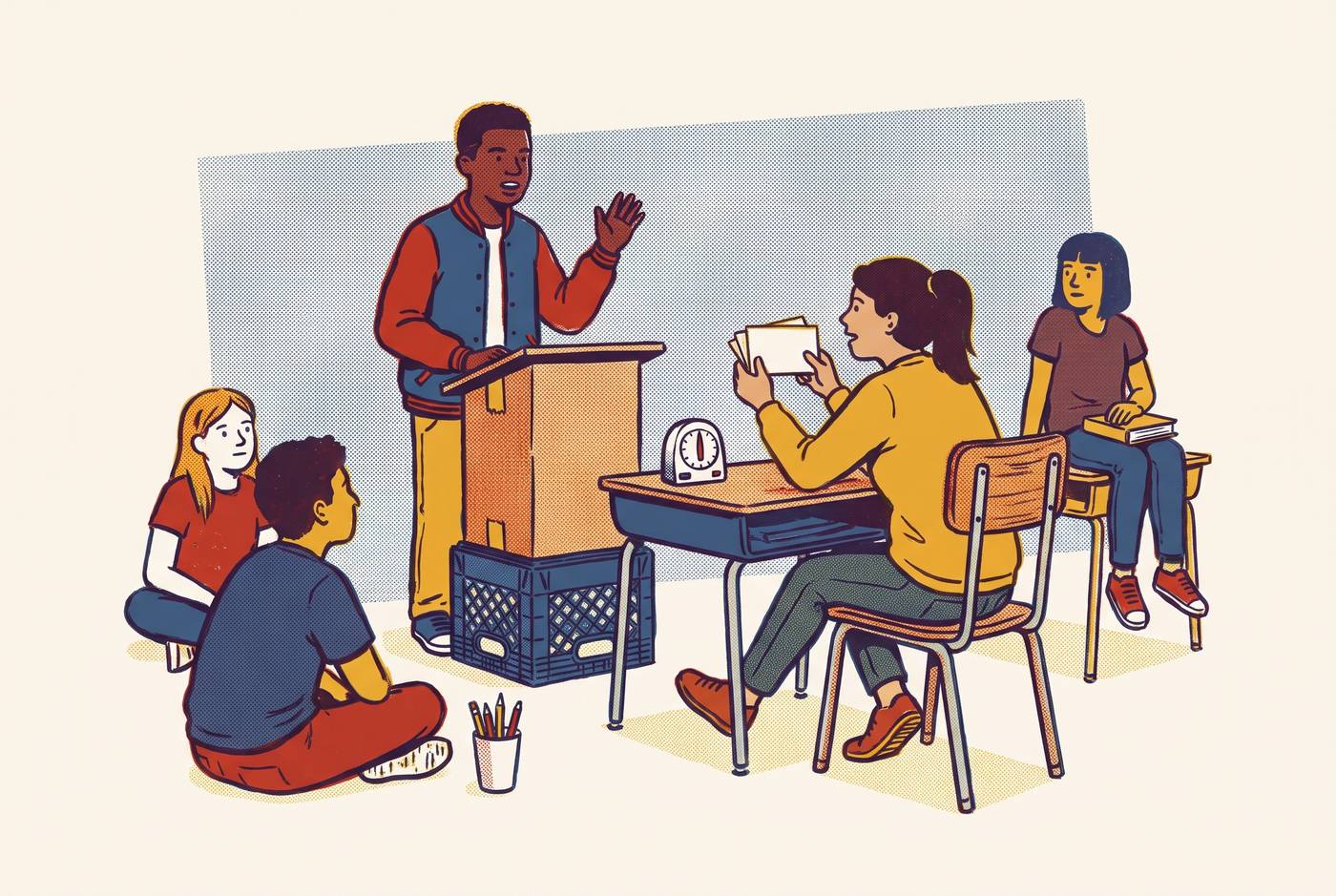
Starting a Debate Program in a School With No Budget
A step-by-step plan for launching debate with free tools.
Starting a debate program in a school with no budget requires a practice structure. Free NSDA resources, peer judging, and free structured matches through ArguFight can help underfunded high school programs give students practice without buying coaching services. The workable sequence is to establish internal rounds, add outside opponents, and enter free online competition once students understand the format.
Why schools without money still face a solvable problem
A school starting from nothing faces four distinct gaps. It needs debate expertise, a judging pool, a recurring practice schedule, and a route into competition. Treating those gaps as one funding problem obscures the available solutions. Student coaching can develop expertise, peer judging can support internal rounds, and free resources can supply the first practice plans. Online events then provide a competitive destination without travel and lodging.
The starting conditions are not unusual or disqualifying. Civic Debate Academy reports that most middle schools do not offer debate and most high schools lack a program with expertise. A founder therefore needs a design that works without an established coach. Debate also works for students from elementary through high school. The program need not wait for a group of already accomplished speakers before it begins.
Deciding what kind of program to build before spending a minute on logistics
The first decision is the program’s purpose. A competitive team centers on one formal format, regular preparation, and tournament readiness. A speaking and advocacy society instead emphasizes civic discussion and persuasive speaking, without making every meeting resemble a tournament. These are different commitments, and recruitment becomes confusing when a new program promises both without explaining which comes first.
The practical zero-budget default is a broad debate club with one clear promise, growing toward competition after students establish a meeting habit. Figuring out every meeting as it approaches is not the same as allowing the program to develop. A first-month plan gives students something definite to join and gives an adviser something concrete to supervise. The founding group can put its primary promise on a poster in one sentence. “Practice making arguments, listening, and responding in regular debates, then work toward a public showcase.”
Getting official approval and finding an adviser without debating experience
That promise becomes the basis for school approval. The initial deliverable is a one-page club launch brief covering the approval process, a possible meeting room, and a short list of potential advisers. With a prepared plan rather than a vague request, the approval path and adviser search can take under a week.
The adviser need not be a trained debater. The request should include the first four meeting plans and explain that students will handle recruitment and attendance. The adult role is supervision, help navigating school rules, and occasional perspective. These roles should be clear before anyone agrees to take them on. A teacher considering a bounded responsibility has a clearer basis for deciding than one asked simply to “help start debate.”
Building a founding group that does real work, not a mailing list
Once the institutional path is clear, recruitment should begin with a working group of five to eight students. Ownership is the immediate goal. A small group with assigned tasks is more useful at this stage than a large group waiting for someone else to organize it. The roles can be temporary, with responsibilities shared where necessary.
The lead keeps the plan moving and communicates with the adviser, while the operations lead handles rooms, attendance, and supplies. The recruitment lead prepares posters and invitations. The debate lead selects motions and runs the meeting format, while the inclusion lead helps beginners feel welcome. A communications lead manages the group chat and reminders. Sharing the work keeps every unfinished task from falling back on one founder, and the group can hold its first public meeting before it has a permanent committee.
Scheduling the first eight meetings so the club survives past week two
The first meeting should introduce what an argument is and establish the practice routine. The National Speech & Debate Association publishes “Running the First Practice,” a free resource focused on the opening practice of the season. That gives inexperienced founders a starting point. Meeting two moves into the first short debate, and meeting three covers research and evidence basics. Meeting four teaches rebuttal and listening, so students learn to answer an opponent as well as give the speeches they have prepared.
At meeting five, students learn about debate formats and where they can compete. Meeting six is a practice round with feedback, followed by a team challenge or mini-tournament at meeting seven. Meeting eight becomes the public showcase. This progression gives the semester a visible destination and provides something concrete for recruiting the next cohort. It also removes the recurring burden of inventing a meeting the night before students arrive.
The early rounds can use a compact timed format. Each opening speech lasts two minutes, followed by two minutes of clarification questions, two minutes per rebuttal, and one-minute closing statements. Audience feedback and a vote finish the round. Reusing that structure gives students a stable routine while the skill focus changes across meetings.
Picking topics students can actually argue without weeks of research
A ready-made motion removes one source of silence. The NSDA publishes resolutions that founders can use without writing their own, although a published topic does not remove the need to learn about its subject. Its Public Forum resolution for Nov/Dec 2026 is “Resolved: European members of NATO should ratify the Treaty on the Prohibition of Nuclear Weapons”. Its Policy resolution for the full 2026-27 season is “Resolved: The U.S. federal government should establish national health insurance in the United States”. These are format-specific options.
For beginner rounds, a coin flip can assign sides. Students then practice building a case for a position they may not personally hold, without the adviser preparing separate assignments in advance. The technique simplifies preparation. It does not supply factual knowledge. Founders should also distinguish public resolutions from member-only instructional materials. The NSDA’s self-guided Public Forum topic analysis and coaching guides require membership and should not be counted as resources free to the general public.
How can a debate program get practice judging without hiring anyone?
Peer judging provides the first no-cost judging pool. Students who are not speaking can assess a round using a rubric published before it begins. The rubric gives students a shared guide for feedback, so the result depends on more than which side the audience prefers.
Platforms can produce written, scored verdicts within seconds of the final speech, giving students another way to review a practice round. A program using AI judging should publish the scoring criteria in advance and use the same rubric across comparable rounds.
Researchers at Universidad de Buenos Aires reported in the 2026 NeurIPS paper “Humans Correct Their Judgments Through Debate, but Weaker AI Models Do Not” that debate improved human judging accuracy, while the effect did not reliably hold for weaker AI models. That finding limits what a program should infer from an automated verdict. AI feedback can support practice without becoming the final authority when competitive outcomes are at stake.
Using experienced students to fill the coaching gap
Students can start coaching once they have learned enough through practice to teach others. Established programs use research prepared by older students to support younger debaters, and a second cohort creates the basis for mentorship. Students with debate experience can look over flows, the notes used to track a debate, between rounds. They can also suggest strategic adjustments and explain what worked or failed, within the bounds of their own experience.
The adult adviser handles school compliance and supervises logistics, supported by the operations lead, while student coaches handle debate content. That division keeps subject expertise from becoming a condition of adult participation.
The pipeline does not exist in month one. If no student has debated before, the first year should use the free first-practice guide and the eight-meeting structure to build basic fluency. Mentorship can develop in year two from that shared experience. Presenting it as an immediate substitute for an expert coach would promise a resource the school has not yet built.
Building the practice habit through a progression from internal rounds to AI opponents to live competition
Internal rounds come first because students need format fluency before facing strangers. The combination is straightforward and repeatable each week. A timed round, coin-flip side assignment, and peer judging with a published scorecard give students an opponent and a result from the beginning. Feedback after a speech then becomes part of the next attempt.
Students next practice on their own against AI opponents. This gives them another way to practice making and answering arguments before they move into live-matched 1v1 rounds. The distinction between an AI opponent and AI feedback is important here. That makes it a named option for free practice, but does not establish that every AI practice function is free or available on that platform.
Live opponents then extend practice beyond the club. The ladder resembles chess training more than open classroom discussion because repetition occurs against opposition and under judgment. Skipping directly from no experience to a tournament against established programs risks a discouraging introduction. Internal fluency is therefore a preparation stage.
Making the case to an administrator who needs a reason beyond "it would be fun"
The strongest administrative case begins with learning outcomes. The Boston Debate League study by Schueler & Larned, published in 2023, found reading benefits from debate participation. The “Literacy with a Purpose” study, conducted in partnership with a debate organization, found growth in reading comprehension and writing compared with non-debating peers. These findings support debate as an academic activity, without establishing that it outperforms programs specifically designed to teach reading and writing.
A mixed-methods study published in October 2026 examined structured weekly online debate rooted in constructivist theory and reported a positive effect on high school students’ critical thinking skills. The studies do not guarantee identical results in every new club. Still, the studies give an administrator more reason to support a program than enthusiasm alone does, especially if students will practice regularly.
AI-assisted schoolwork makes that rationale particularly timely. Debate requires students to formulate arguments, listen to challenges, and respond publicly, so the activity directly exercises capabilities that an assigned written product may not reveal. The pitch to an administrator should show how the plan for running the program will help students meet those demands. The school is being asked to support a zero-budget practice program with one willing adult supervisor, a defined schedule, and a public milestone.
The competition pathway from internal showcase to national circuit, all at low or no cost
The public showcase establishes the starting point for outside competition. For a school without an existing team, the route includes securing an adviser, recruiting classmates, registering with the NSDA, and using free resources from its website and Tabroom.com. The competition plan needs to distinguish no-cost opportunities from events or memberships that may require payment.
If the program later pursues the National Speech & Debate Tournament, the NSDA identifies its annual district tournament series as the primary qualification route.
Year one needs a smaller competitive target. Completing one full internal showcase and one virtual tournament gives students, the adviser, and administrators evidence that the program functions. Students may still lose early rounds against established teams because, even with preparation, they have less experience. It gives them a practiced format in which to understand that loss and work on the next round. The next cohort can then join an operating program without waiting for funding.