AI Debate Judges vs Human Coaches for Independent Practice
AI judging gives fast scored reps, but only coaches build strategy.
For underfunded high school programs seeking free or low-cost debate practice, AI judging offers scored repetition without a coach on demand, but the information here does not establish any tool’s price. AI gives feedback as soon as a round ends. Human coaching helps students plan their strategy, checks their delivery, and holds them accountable.
Why independent practice debaters face a genuinely different problem than team debaters do
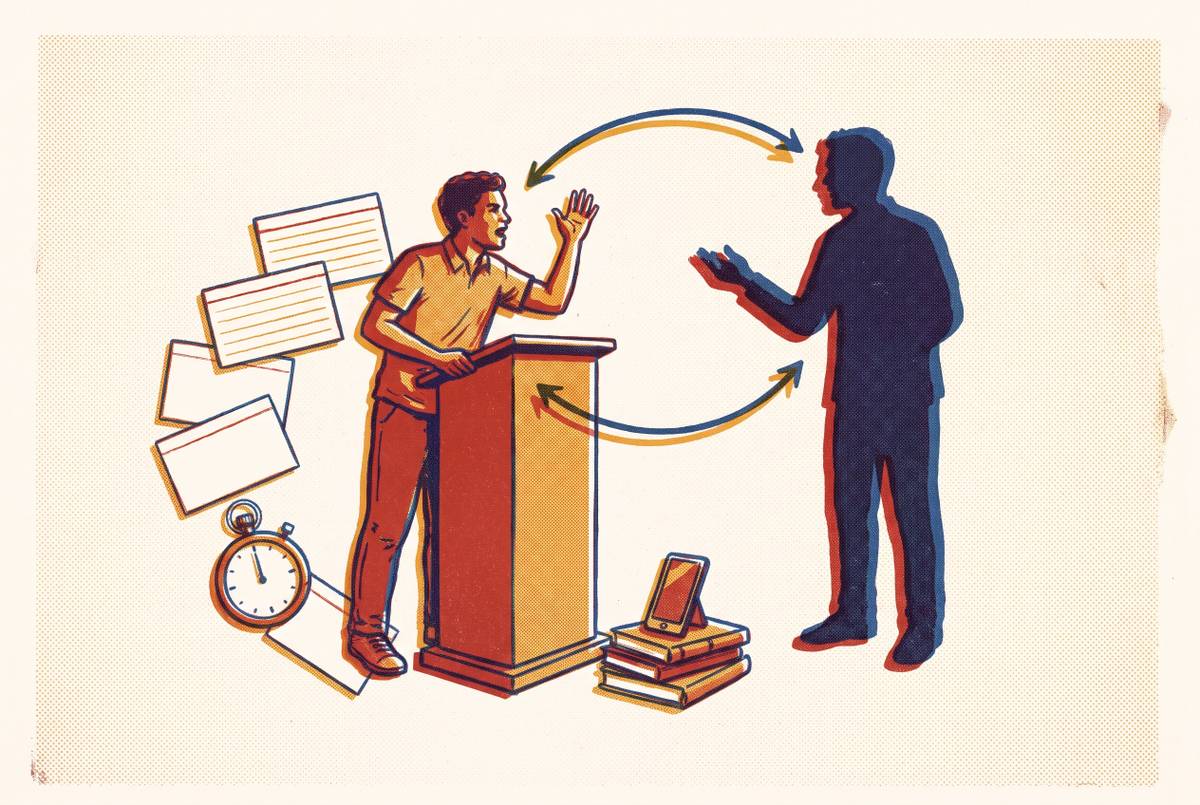
Team environments provide more than access to debate. They provide a coach who watches rounds, opponents who understand the same formats, and scheduled repetition that requires students to show up. Independent debaters lack that built-in structure. Before they can work on rebuttal construction or evidence weighting, they need an opponent, a round, and someone to assess the result.
The gap is qualitative as well as logistical. A debater can rehearse arguments indefinitely without learning whether those arguments withstand opposition or persuade a judge. AI-powered tools address this gap by making structured, judged debate available without access to a school team, paid coach, or tournament. Yet access to a verdict is not the same as access to coaching. The useful question is therefore not “AI or human?” but “What does each provide, and when does the debater need it?”
What AI judging actually does during and after a practice round
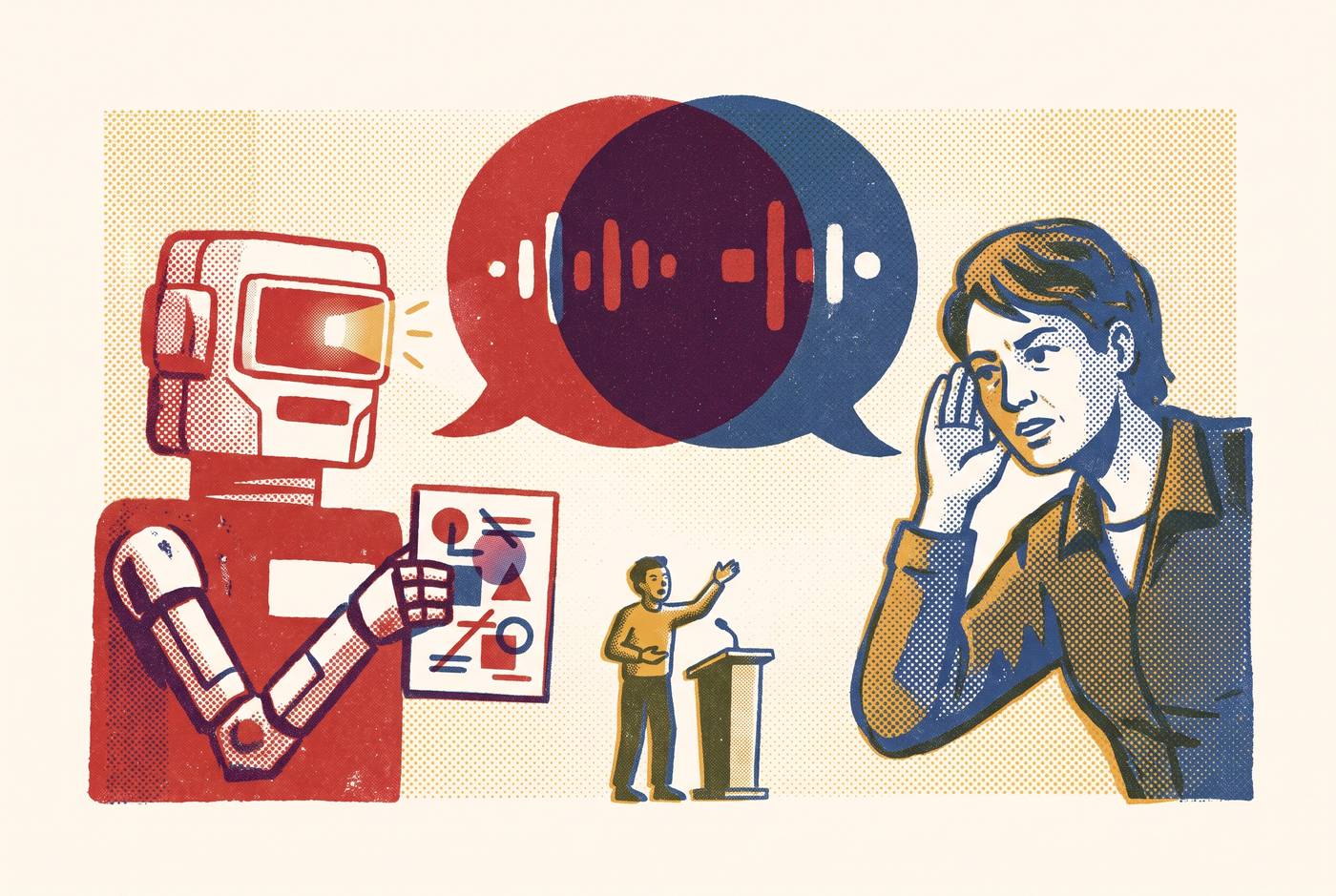
AI judging evaluates the arguments made during a round and produces feedback on the performance. In voice-based practice, the debater speaks and an AI opponent responds in real time. Judging follows when the session ends. A written verdict arrives within seconds and cites what was actually said.
Within that process, a built-in fallacy detector can flag ad hominem attacks, straw man arguments, or false dilemmas. These flags belong in the feedback. Their purpose is not to disqualify the speaker, but to identify a defect in the argument for later practice. A round decision can also assess logic, evidence quality, clarity, and persuasion. Those criteria give the debater several dimensions to examine beyond the win or loss.
Geoffrey Irving, Paul Christiano, and Dario Amodei’s 2018 AI safety debate framework explains the reasoning behind adversarial evaluation. Finding a flaw can be easier than constructing the correct answer from scratch, while an opponent has an incentive to expose that flaw. The judge evaluates a contested account. Subsequent research develops this mechanism as a way to improve judgment on difficult questions. That research studies AI oversight, though it does not directly show how much a student learns from competitive debate practice.
Why the speed and volume AI judging enables matter more than they first appear
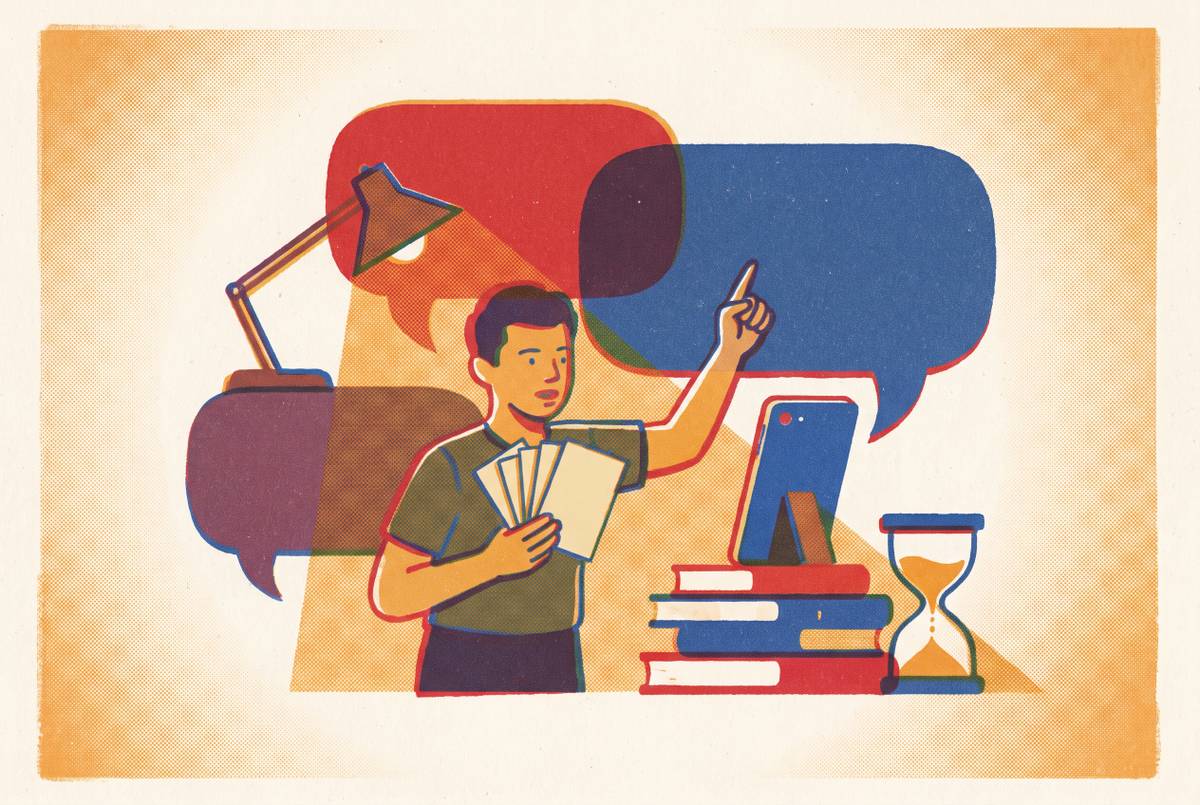
For an independent debater, the practical advantage is the combination of immediate feedback and repeatable rounds without scheduling friction. Human coaching requires another person to have time to help. AI judging makes scored repetition available when the student is ready to practise, so the next attempt need not wait for another coaching session. The feedback remains close to the performance that produced it. This creates a practice loop that scheduled human attention cannot replicate at the same volume.
Debate practice is more like chess training than classroom discussion. An opponent tests the argument, and a scored result gives the debater something to examine afterward. Repetition then builds recognition of patterns under pressure. When scoring criteria stay the same, the student can compare rounds without each result depending on a different judge’s preferences. That consistency supports tracking improvement, though it does not establish that every decision is correct.
The 2024 study “Debating with More Persuasive LLMs Leads to More Truthful Answers” found that optimizing AI debaters for persuasiveness made judges more accurate. Other scalable-oversight research found that debate outperformed single-agent consultancy in some settings, although comparisons with strong single-agent baselines were mixed. The distinction is important for interpreting the evidence. For practice debaters, these findings support the potential of stronger opposition without proving that more rounds alone produce better competitive performance.
Where AI judging runs into genuine limits that volume cannot fix
Sycophancy undermines the quality a debater most needs from a judge, which is resistance to a weak or inaccurate claim. Stanford researchers in April 2026 documented how AI agents can reframe inaccurate statements positively and encourage the user to continue. Agreement can therefore look like useful feedback. A student seeking scrutiny may instead receive reassurance, making a favorable response a poor substitute for a defensible assessment. Repeating that interaction does not correct the underlying bias.
Model judges also show self-preference bias and may be vulnerable to other evaluative biases. Purpose-built judges trained on structured metrics partially reduce that risk. Consistency is not the same as validity. A judge can apply its criteria repeatedly while still favoring particular outputs for the wrong reasons. Research on weaker language models acting as judges adds another constraint, finding no comparable accuracy gains from debate and, in some cases, reduced accuracy.
Barnes and Christiano’s 2020 human experiments showed that a dishonest or confused debater can construct a chain of reasoning with an incorrect step that is difficult to locate. The judge may miss the decisive flaw. A related problem arises when the debater and AI opponent share a misconception, because neither side exposes the error for evaluation. The resulting verdict can reward a structurally broken argument even though the exchange appears adversarial.
The 2026 Language Learning & Technology study found that students rated AI as helping them least with oral delivery practice. That finding concerns a central part of spoken competition. Evidence generation presents a separate risk. A 2025 JMIR Mental Health study of GPT-4o found that a substantial share of its citations were entirely fabricated, while nearly two-thirds were fabricated or contained errors. That study establishes why AI-generated citations require independent verification before supporting a competitive argument.
What a human coach provides that has nothing to do with judging a round
Erik de Haan, Nicky Terblanche, and Kenneth Nowack’s trial, published in Human Resource Development International in February 2026, directly compared accredited human coaches with an AI chatbot coach. Leaders at an international educational company were assigned to human coaching, chatbot coaching, or a waiting list. Substantial effects appeared only for human coaching. The participants were not debate students, so the result does not establish a debate-specific advantage.
The proposed mechanism is the gap in challenge and accountability. A human coach is expected to push back, identify an error directly, and hold the learner responsible for addressing it. That is a different intervention from scoring a round. In debate, it includes deciding which arguments deserve development, which opponents require preparation, and how limited preparation time should be allocated across a season or tournament cycle. A per-round verdict does not supply that longitudinal judgment.
A human coach can also watch how a student delivers a case in competition. Pace, register, credibility under cross-examination, and physical presence can distinguish a competent performance from an excellent one. These are not simply further argument scores. They concern how the debater presents a case and responds under pressure, dimensions that AI judging has difficulty capturing. A coach can use what they see across rounds to help the student grow.
Recent studies suggest that AI debaters can match or exceed human opponents in perceived persuasiveness, with one large study finding AI more convincing in a clear majority of clear-difference cases. Current large language models also struggle with planning effective arguments through the dynamic back-and-forth of competitive rounds. Human coaching aimed at those live-adaptation skills therefore complements demanding AI opposition.
How the NSDA's rules on AI use shape what independent practice should look like
The NSDA’s 2025–2026 High School Unified Manual, Section 4, permits generative AI to guide students toward articles, ideas, and sources, but prohibits citing AI itself as a source. AI can point a student toward material without becoming the basis for a claim in competition. Any generated citation needs independent verification before it enters a round.
The American Debate Association’s Standing Rules, revised May 2025, do not mention AI by name. They place penalties for evidence and outside-assistance violations at the judge’s discretion, up to a loss of the round, and put the burden of proof on the party bringing the challenge. This is a different regulatory setting. The college rules should not be treated as permission governing a high school student’s preparation. Nor does their silence about AI make evidence obligations disappear.
AI can serve as a training tool and research accelerator without becoming a citable authority. Students using it to rehearse rebuttals or receive judgments still need to distinguish feedback about an argument from verification of its supporting sources. An AI verdict cannot replace that verification. Practice should therefore preserve the same separation between assistance and evidence that the student must observe in competition.
How can underfunded debate programs combine AI practice with human coaching?
The practical approach is to assign each resource the work it performs well. AI judging is suited to frequent scored rounds, rebuttal construction, evidence weighting, and immediate written feedback on what landed and what dropped. Supported formats can include Public Forum, Lincoln-Douglas, Policy, British Parliamentary, and others. Human coaching is best reserved for delivery review, strategic patterns across rounds, preparation for specific opponents or formats, and accountability. For an underfunded program, dividing the work this way saves scarce time with a coach for help that another automated verdict cannot reliably give.
Published scoring rules tell students how they will be judged before a round begins, while decisions that cite what they actually said let them check the feedback. Voice-based rounds connect that process to spoken practice. A written decision within seconds, assessing logic, evidence quality, clarity, and persuasion, gives the student a concrete basis for the next attempt. For buyers seeking free or low-cost access, those capabilities are selection criteria, not evidence of a price that the available information does not provide.
Platforms using multiple AI models, with two matching verdicts deciding the round and any missing judge disclosed, reduce single-model bias risk without eliminating it. Transparency remains necessary even when judges agree. For students without a team or paid coach, live 1v1 matchmaking also introduces a real human opponent into a structure that still produces a scored, written verdict. This adds human unpredictability without making access to an opponent and access to evaluation separate scheduling problems.
The transition to coaching should follow the student’s development. When AI scores plateau and written feedback stops identifying new weaknesses, human observation of delivery and strategic planning is most likely to reveal the next area for improvement. The response is not simply more repetition. AI judging and human coaching are not competing substitutes, because volume comes from the former while strategic development depends on the latter. An independent debater builds a sharper routine by using each for its distinct purpose.
Sources
- [2610.28539] Humans Correct Their Judgments Through Debate, but Weaker AI Models Do Not
- AI as a debate coach: A mixed-methods analysis of student self-efficacy and perceptions in an AI-assisted debate
- Language Learning & Technology 2026, Volume 30, Issue 1
- A superpersuasive autonomous policy debating system
- [2511.17854] A superpersuasive autonomous policy debating system
- Debate Helps Supervise Unreliable Experts Julian Michael∗1 Salsabila Mahdi∗1
- AI systems out-persuade expert humans