Lincoln-Douglas Debate: The Format, Explained for Debaters Who Compete Alone
One debater on each side, seven speeches, four minutes of prep and a ballot that tells the judge to weigh only what they could clearly understand. Here is how the format works, read for debaters who prepare on their own and argue in English that isn't always their first language.
Guide · Updated
What Lincoln-Douglas debate is
Lincoln-Douglas (LD) is a one-on-one debate format. Two debaters argue a resolution: the Affirmative argues for it and the Negative against it. The National Speech & Debate Association (NSDA), which runs it as a main event for both high school and middle school, describes a round as constructive speeches, rebuttals and cross-examination lasting about 45 minutes.
LD is often called a "values" debate. Its resolutions are about how things ought to be rather than how they are, and the NSDA says they focus on morality, philosophy and justice, often setting competing values against each other, such as individual freedom against the collective good. Debaters can't choose their side: over a tournament you argue both, round by round.
Because there is no partner, LD is the format most open to a debater whose school has no team. Everything below follows the NSDA's event page and its official ballot. Leagues and tournaments can adapt the format, so check the invitation for any tournament you enter.
Speaking order and speech times
| Order | Speech | Time | Who speaks |
|---|---|---|---|
| 1 | Affirmative Constructive (AC) | 6 minutes | Affirmative |
| 2 | Cross-examination of the Affirmative | 3 minutes | Negative asks, Affirmative answers |
| 3 | Negative Constructive (NC) | 7 minutes | Negative |
| 4 | Cross-examination of the Negative | 3 minutes | Affirmative asks, Negative answers |
| 5 | First Affirmative Rebuttal (1AR) | 4 minutes | Affirmative |
| 6 | Negative Rebuttal (NR) | 6 minutes | Negative |
| 7 | Second Affirmative Rebuttal (2AR) | 3 minutes | Affirmative |
Each debater also has four minutes of preparation time to use during the round, before any of their own speeches, in whatever amounts they choose. Add the speeches up and each side speaks for 13 minutes: the Affirmative in three speeches (6, 4 and 3 minutes), the Negative in two (7 and 6). The Affirmative speaks first and last.
What each speech does
- Affirmative Constructive: presents the Affirmative case in full. It is usually written and practised before the tournament.
- Negative Constructive: presents the Negative case and answers the Affirmative case. It is the longest speech in the round, so it has to do two jobs.
- First Affirmative Rebuttal: answers the Negative case and rebuilds the Affirmative case, in four minutes, against a seven-minute speech. For most debaters this is the hardest speech in the round.
- Negative Rebuttal: the Negative's last word. It answers the Affirmative, rebuilds the Negative case and gives the judge the reasons the Negative should win, known as voting issues.
- Second Affirmative Rebuttal: answers the Negative's voting issues and gives the reasons the Affirmative should win.
The NSDA ballot tells judges to disregard new arguments made in rebuttals. New evidence for a point already made is allowed, and so is answering an argument the opponent has made. It also says neither debater should be rewarded for a speech that ignores the other side: after the cases are read, the round has to clash over the main arguments.
Value and criterion: the framework
What sets LD apart from other formats is the framework. A case typically opens with a value, the highest goal the resolution should be judged by (justice, for example, or human dignity), and a criterion, the standard that says how to tell whether that value is being met. The arguments that follow, often called contentions, show that the debater's side of the resolution meets the criterion better.
The ballot puts the burden this way: each debater has to prove their side of the resolution more valid as a general principle, not completely true. So a round is often won by whichever framework the judge accepts, and by showing that you win under your opponent's framework too. Debaters draw on philosophy for this, and the NSDA encourages them to research both topic literature and relevant works of philosophy.
Cross-examination
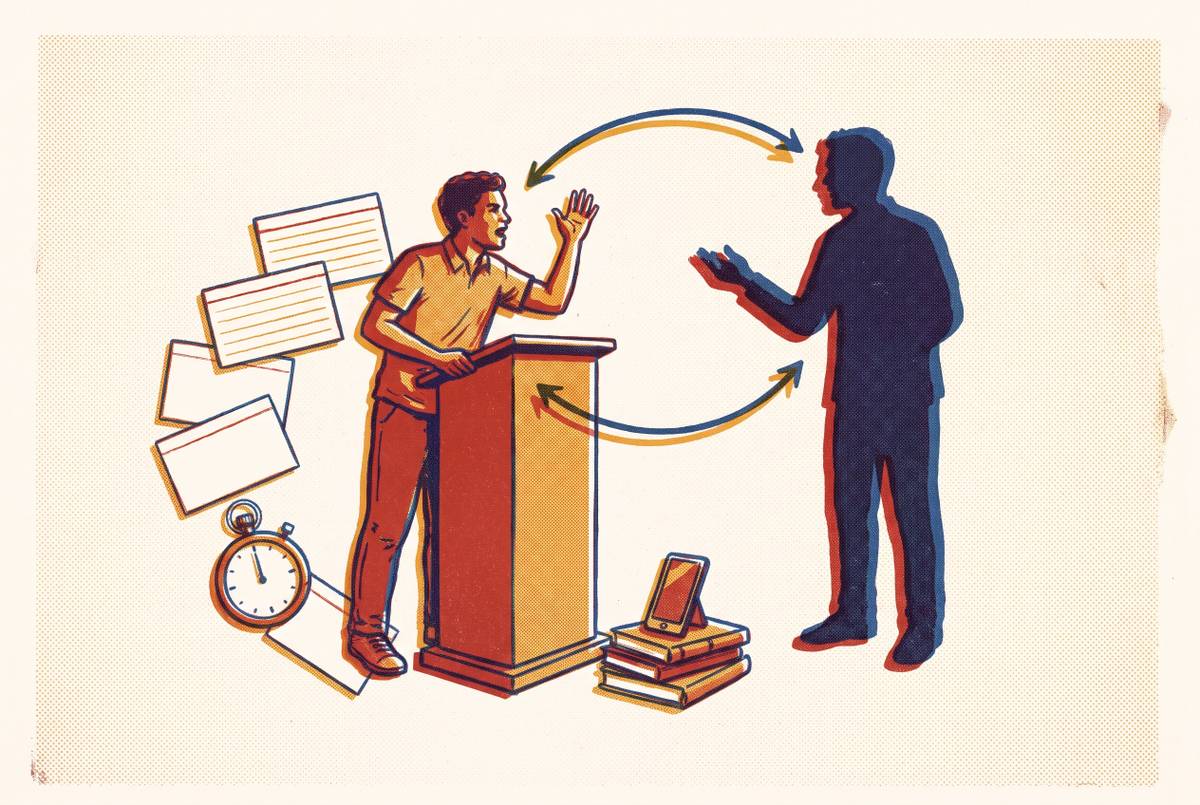
After each constructive, the other debater gets three minutes to ask questions, and the speaker answers. The ballot says cross-examination should clarify, challenge or advance arguments. What is said in it only counts once it is used in a speech: an admission you win in cross-examination needs to be brought up in your next speech for the judge to weigh it.
Cross-examination is unscripted and fast, which is where a second-language speaker can feel the most pressure. It helps to have a few short, set phrases for buying a moment ("Could you repeat the last part?" or "Let me make sure I understand the question") and for keeping answers brief ("Yes, and the reason is"). Asking for a question to be repeated isn't a weakness. It's a normal part of the exchange.
Evidence, prep time and the internet
LD debaters can use evidence they prepared before the round, and under NSDA rules internet access is allowed during the round unless the tournament says otherwise. Because rules on devices and evidence vary between leagues and tournaments, check the invitation and any state or league rules before you rely on a laptop.
Four minutes of prep has to last the whole round. A common way to split it is to save most of it for your rebuttals, which are the speeches you can't write in advance. Track how much you use in practice rounds so you learn what you actually need.
How topics are chosen, and the current one
The NSDA's Lincoln-Douglas Wording Committee writes a set of possible resolutions each summer and assigns two to each two-month topic period: September/October, November/December, January/February and March/April. A week before each period starts, NSDA chapter advisors and member students vote between the two. The National Tournament has its own topic.
The November/December 2026 topic is "Resolved: De-extinction is unethical." There is also an optional novice topic that stays the same every year, for new debaters in their first two months: "Resolved: In the United States, national service ought to be mandatory." The NSDA publishes sample cases for it. Topics change every two months, so check the NSDA's Topics page for the current resolution before you prepare.
How Lincoln-Douglas debate is judged
On the NSDA ballot, the judge marks a decision (Affirmative or Negative), gives each debater speaker points and writes comments and a reason for decision. The decision and the points are separate: a judge can give the win to the debater with fewer points, and the ballot has a box to mark a low-point win.
| Points | What they mean |
|---|---|
| 29–30 | Outstanding |
| 27–28 | Above average |
| 24–26 | Average |
| 20–23 | Below average |
| Below 20 | Unethical or inappropriate behaviour |
Judges are told to evaluate both sides objectively, because debaters can't choose their side, and to decide on the arguments the debaters made, not on their own opinions or the arguments they would have made. Judges come to LD with very different experience of the format, so read the round for the judge in front of you.
What the ballot means for second-language speakers
Unlike the World Schools rules, the NSDA ballot says nothing about accents or about English as a second language. What it does say is about clarity:
Communication should emphasize clarity. Accordingly, a judge should only evaluate those arguments that were presented in a manner that was clear and understandable to them as a judge.
The rule cuts both ways. It doesn't ask you to sound like any one country: an argument the judge understood counts in full, whatever your accent. But an argument the judge didn't understand doesn't count at all, and it is the judge's understanding that matters, not yours or your opponent's. In practice that means signposting ("My second contention is…", "On their framework…"), slowing down for the tagline of each argument, and repeating the value and criterion in words the judge can write down.
Delivery speed varies a lot between circuits and judges, from conversational to very fast. If you don't know a judge's preferences, ask before the round how fast they are comfortable with and whether they want anything repeated. It is a fair question, and it helps you meet the clarity rule.
How it compares with World Schools
Debaters who know World Schools, the format of the international schools championship, will notice four differences. LD has one debater a side instead of three. It uses cross-examination periods rather than points of information during speeches. Its rounds are about 45 minutes, and its topics are known in advance for two months rather than mixing prepared and impromptu motions. And it is judged on a single ballot with speaker points from 20 to 30, not on World Schools' content, style and strategy marks. Our World Schools debate guide covers that format in full, and our comparison of Indian and US debate formats places LD among the other US formats.
Practising Lincoln-Douglas on your own
LD is the format you can prepare for most completely alone, since every speech in the round is yours or your opponent's:
- Write both cases. You'll argue both sides of the topic over a tournament, so write an Affirmative and a Negative case, each with its own value and criterion, and time each one: 6 minutes for the AC and no more than 7 for the NC, leaving room in the NC to answer the Affirmative.
- Say your framework in two sentences. If you can't state your value and criterion and why they fit the resolution in two sentences, a judge won't be able to write them down either.
- Drill the 1AR. Record yourself reading your Negative case, then give a four-minute rebuttal against it as the Affirmative. Do it until you can answer seven minutes of argument in four without dropping your own case.
- Practise cross-examination both ways. Write the ten questions you'd most hate to answer about your own case, then answer them out loud in under three minutes. Then write ten you'd ask your opponent.
- Test for clarity. Give a speech to a listener who doesn't debate, ideally one who speaks a different variety of English, and ask them to tell you your value, criterion and main arguments. If they can, a judge can too.
Where to check the current rules
The NSDA sets the format for its own tournaments, and state associations, leagues and invitationals can set their own times, evidence rules and device rules. Before you compete, check the tournament invitation, the NSDA's Lincoln-Douglas event page and its Topics page for the current resolution. The sources below are where this guide's facts come from.
Sources
- Lincoln-Douglas Debate (National Speech & Debate Association)
- Lincoln-Douglas Debate Ballot, blank sample (National Speech & Debate Association)
- Topics: Lincoln-Douglas (National Speech & Debate Association)
- What to Expect Coaching Lincoln-Douglas Debate (National Speech & Debate Association)
- Start Here: Teaching Lincoln-Douglas (National Speech & Debate Association)